If you run a small practice in Ohio, you already know the feeling: it’s 6:45 PM, the last patient left an hour ago, and someone on your team is still chasing a denied claim from Buckeye Health Plan because the prior authorization code didn’t match what CareSource requires for the same procedure. Billing isn’t just paperwork — it’s the thing standing between the care you provided and the money you’re owed for it.
This guide breaks down what outsourced medical billing for small clinics in Ohio actually costs, how it interacts with Ohio’s Medicaid managed care plans, what compliance details genuinely matter, and how to vet a partner without getting burned. Whether you’re weighing that against keeping billing in-house, searching for medical billing services for small practices in Ohio, or specifically looking for a HIPAA-compliant medical billing company in Ohio, this is written to give you a real answer.
The honest answer is it depends on what’s actually broken. A few signals reliably mean it’s worth a serious look.
Your denial rate is climbing and nobody has time to find out why. A denial rate above 10–12% usually points to something systemic—wrong modifiers, missed prior authorizations, or eligibility that wasn’t verified. A billing partner focused on how to reduce claim denials for Ohio practices should be able to tell you their average first-pass acceptance rate without hesitating. Rapid ClaimCare’s clients typically see first-pass acceptance rates in the high 90s, well above the industry average of roughly 85–90%.
You’ve had biller turnover in the last year. Every time you lose a biller, you lose institutional knowledge about your specific payer mix, and the new hire’s ramp-up period shows up directly in your A/R aging report.
Your front desk or nurses are doing billing on the side. Common in small practices, and usually a sign you’ve outgrown the current setup.
You’re growing faster than your back office. Adding a provider or a second location multiplies claim volume, but billing staff doesn’t scale linearly.
If two or more of these sound familiar, the math below is worth running.
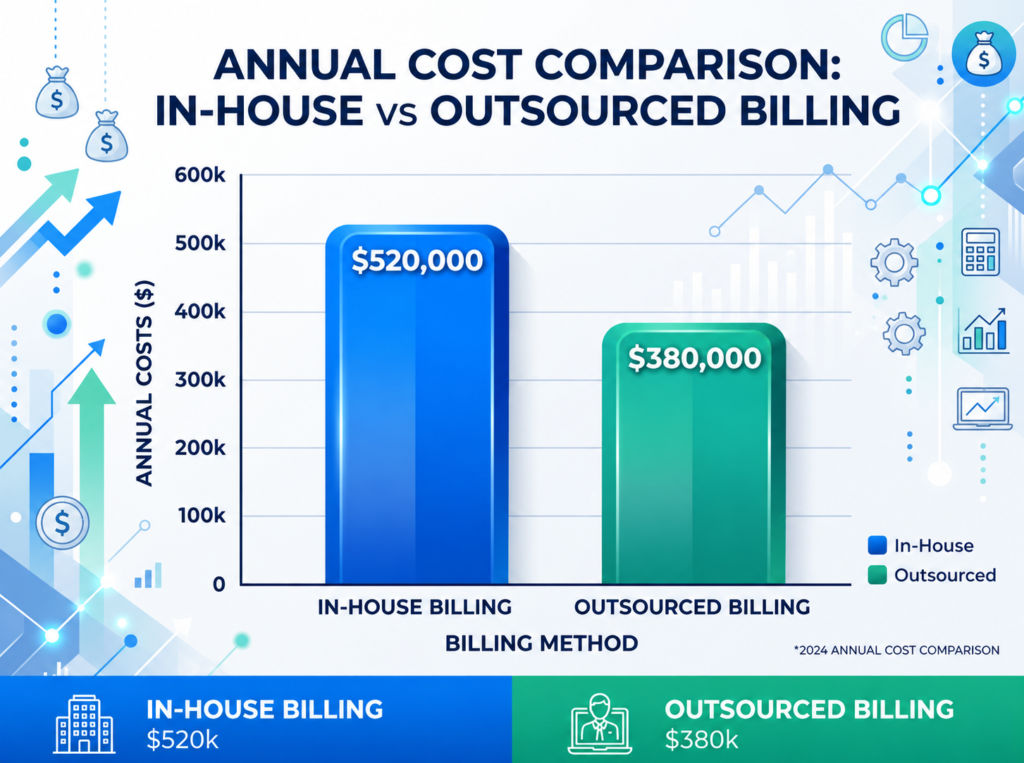
Most articles quote a percentage range and stop there. Let’s do the actual math.
A worked example. Say you’re a solo family medicine practice in Ohio collecting $650,000 a year.
Medical billing in-house:
Outsourced, at a typical 3–8% of collections:
For most independent physicians in Ohio looking for affordable outsourced billing, that’s where the decision usually gets made. But the percentage fee is only half the picture—the real ROI shows up when a partner also increases what you collect by reducing denials and speeding up reimbursement. This is why Rapid ClaimCare prices with no setup fees and no long-term contracts: you should be able to see the impact on your collections before you’re locked into anything.
Not sure where your practice lands on this math? Rapid ClaimCare’s free revenue audit reviews your current first-pass acceptance rate, denial patterns by reason code, and days in A/R — and you get a written report within 48 hours, not a sales pitch. Book your free consultation →
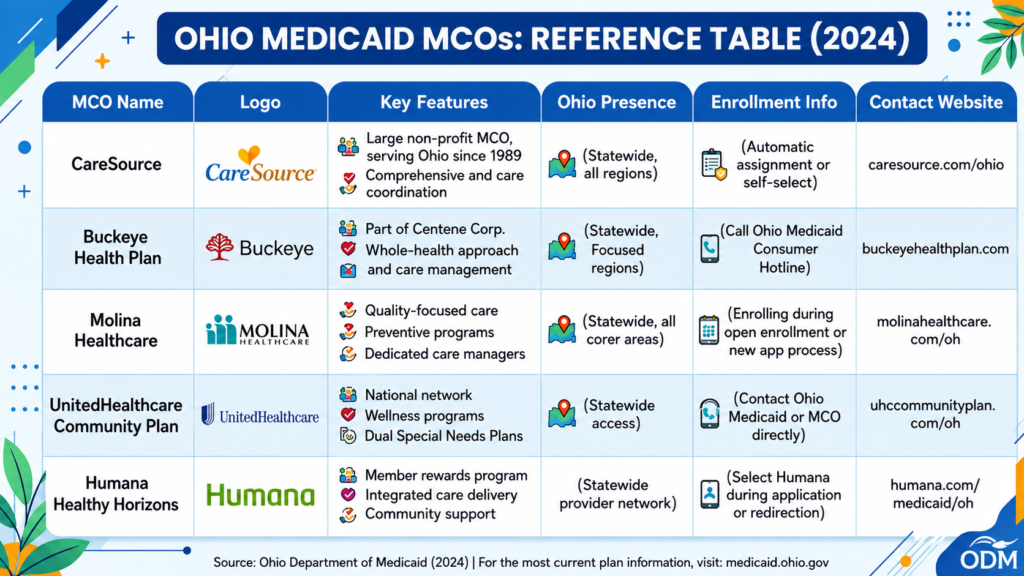
This is the most Ohio-specific piece of this decision, and it’s where a lot of billing content stays surface-level. Ohio Medicaid is managed through five MCOs, and if your patient panel includes any meaningful Medicaid population, your partner needs to know these plans well — not just know they exist.
A hospital system has dedicated staff per payer. A small clinic usually has one or two people handling all five MCOs plus Medicare and commercial plans—and treating “Ohio Medicaid” as one uniform program is one of the most common, avoidable sources of denied revenue for small practices. Rapid ClaimCare’s revenue cycle management team works with Medicare, all state Medicaid programs, and the major commercial carriers, which means Ohio Medicaid’s payer-specific quirks are handled as part of standard claims work—not treated as an edge case.
The question to actually ask a vendor: don’t ask, “Do you handle Ohio Medicaid?” — every vendor says yes. Ask how they handle prior-auth differences between specific MCOs. A vendor with real experience answers specifically.
Ohio has a prompt-pay law that sets timelines for how quickly insurers must process and pay clean claims. A good billing partner should actively track payer compliance with these timelines and escalate on your behalf rather than just submitting and waiting—which is essentially what denial management and appeals are built for: identifying denial root causes and managing appeals to recover revenue instead of writing off aging claims.
Any HIPAA-compliant medical billing company in Ohio should have encrypted data handling and a signed business associate agreement as a baseline. Rapid ClaimCare signs a BAA with every client, uses 256-bit AES encryption for data in transit and at rest, and undergoes quarterly third-party HIPAA compliance audits — worth confirming with any vendor you’re evaluating, since it’s a baseline requirement, not a differentiator on its own.
Not every small Ohio practice bills the same way.
Rural Health Clinics (RHCs) and Federally Qualified Health Centers (FQHCs) are typically reimbursed through cost-based or encounter-rate methodologies rather than standard fee-for-service—meaning annual cost reporting and specific Medicare/Medicaid rules that a generalist billing vendor may not have direct experience with. If you’re running a rural clinic in Appalachian Ohio or a small farming community, ask a prospective vendor directly whether they’ve managed RHC cost reporting before.
Urban specialty practices—a dermatology group in Columbus, an orthopedic practice in Cleveland — are usually on standard fee-for-service billing but deal with higher-complexity coding and a payer mix often weighted more toward commercial insurance. Rapid ClaimCare’s certified coding team handles ICD-10, CPT, and HCPCS coding across both scenarios, which matters because coding accuracy is usually where fee-for-service denials actually originate.
Almost every billing company’s marketing page says the same three things: transparent, experienced, and HIPAA-compliant. Here’s what actually differentiates a good partner, Cleveland—areomparing medical billing services for small practices in Ohio or searching for medical billing and coding services near you in Ohio:
EHR and practice management compatibility. If you’re on Athenahealth, Kareo, drchrono, eClinicalWorks, NextGen, or Epic, ask exactly how the vendor integrates. Rapid ClaimCare integrates directly with all major EHR and practice management platforms without requiring your practice to switch systems.
Who owns your data if you leave and what your contract actually says. Ask about the notice period required to exit and whether early termination penalties apply—Rapid ClaimCare doesn’t use long-term contracts, specifically so practices aren’t locked in if the fit isn’t right.
How they handle a mid-cycle transition. Ask exactly how claims already in progress at the moment of transition are handled, so nothing falls into a gap. Most Rapid ClaimCare clients are fully onboarded within 5–7 business days, with continuity of claims processing maintained from day one.
Reporting you’ll actually look at. Ask to see an actual dashboard during a demo, not just hear about one.
Questions worth bringing to any vendor call, wherever you’re located across Ohio—Columbus, Cleveland, Cincinnati, Toledo, Akron, Dayton, Canton, Youngstown, Lorain, or a smaller community in between:
Billing complexity varies a lot by specialty:
Whatever specialty you run, the underlying principle holds: ask a prospective vendor for a reference from a practice with your specific specialty and payer mix, not just “small practices” broadly. Rapid ClaimCare’s full list of specialty billing services covers most of these directly.
Is outsourcing medical billing cost-effective for a small Ohio practice? Usually, yes — most small practices spend less on a percentage-of-collections fee than the fully loaded cost of an in-house biller, and a good vendor often improves collections on top of that. A practice with a very clean, low-complexity payer mix and a strong existing biller may see a smaller gap.
How is outsourced medical billing priced in Ohio? Most commonly a percentage of collections, typically 3–8% depending on specialty and complexity. Ask what’s included versus billed separately—onboarding, credentialing, and EHR integration are sometimes extra with other vendors. Rapid ClaimCare’s pricing has no setup fees and no long-term contracts.
What happens to my billing staff if I outsource? This varies by practice—some transition their biller into a different administrative role; others reduce headcount. Worth thinking through before vendor conversations, not after signing.
How long does onboarding typically take? Ask for a specific timeline and how in-progress claims are handled during the switch. Rapid ClaimCare typically onboards practices within 5–7 business days with no billing gap during the transition.
Do outsourced billing companies handle all five Ohio Medicaid MCOs? Most claim to, but the real differentiator is depth of experience across CareSource, Buckeye, Molina, UnitedHealthcare Community Plan, and Humana Healthy Horizons specifically. Ask about claim volume and denial patterns per MCO.
Is my patient data secure with an outsourced billing company? Any legitimate vendor should be HIPAA-compliant with a signed BAA and encrypted data handling. Rapid ClaimCare uses 256-bit AES encryption and undergoes quarterly third-party compliance audits.
Will outsourcing actually reduce my claim denials? It should, if the vendor is doing its job well—ask for their average first-pass acceptance rate for practices similar to yours. A vendor that can’t produce this number hasn’t been tracking it closely enough to trust with your revenue.
Can a billing company work with a practice that sees both Medicaid and commercial patients? Yes, and most small Ohio practices do have a mixed payer panel. Make sure the vendor has real experience with your specific mix, not just one payer type.
Do I need a different billing partner if I run a Rural Health Clinic or FQHC? Not necessarily a different partner, but definitely one with direct RHC/FQHC cost-reporting experience, since that reimbursement model differs meaningfully from standard fee-for-service.
What’s the biggest mistake small practices make when switching to outsourced billing? Not asking what happens to claims already in progress at the moment of transition. Getting a specific answer upfront avoids a temporary revenue dip during onboarding.
Ready to see where your Ohio practice stands? Get a free revenue audit from Rapid ClaimCare — a written report within 48 hours, no obligation.
This article reflects publicly available Ohio Medicaid and billing industry information as of 2026 and isn’t a substitute for direct confirmation with current payer policies.