If you’re evaluating medical billing services for family practice in Illinois, you’ve probably already lived through the reasons you’re looking. A denied wellness visit that shouldn’t have been denied. A biller who left in March and still isn’t replaced. A nagging sense that you’re not billing for everything you’re actually doing.
You’re not wrong. Family practice medical billing carries its own set of headaches that general RCM content doesn’t cover, and Illinois adds a state-specific layer most billing companies don’t bother learning. This guide walks through both: what makes family practice billing genuinely different, what’s unique to Illinois, and how to evaluate whether outsourcing is the right move for your practice.
A cardiology practice bills a smaller number of high-dollar procedures. A family practice bills dozens of shorter visits a day, and that volume is exactly where the trouble starts.
Wellness visits vs. problem visits. Medicare’s Annual Wellness Visit (AWV) is the classic example. A patient comes in for their AWV but also mentions their knee has been bothering them for two weeks. Now you’ve got a preventive visit and a problem-oriented E/M visit in the same encounter, and modifier -25 has to be applied correctly. Get it wrong, and you either lose the E/M payment or invite a payer audit. This single scenario accounts for a disproportionate share of primary care claim denials, and most practices don’t realize how often it’s happening until someone actually audits the pattern.
Chronic Care Management (CCM) and Transitional Care Management (TCM). These are billable services—CCM covers non-face-to-face care coordination for patients with two or more chronic conditions and discharge—and TCM covers the follow-up period after a hospital discharge, and family practices are usually sitting on more eligible patients than they realize. The issue isn’t eligibility or specialty routine; it’s tracking. Without a system flagging who qualifies and logging the required time each month, that revenue just never gets billed.
Vaccine and immunization billing. Family practices bill more vaccine administration codes than almost any other specialty—routine adult immunizations, flu shots, and full pediatric schedules. If your practice participates in the Vaccines for Children (VFC) program, there’s an added wrinkle: VFC-supplied vaccines can only be billed for the administration fee, not the vaccine itself. Mixing that up is a fast way to get a claim kicked back.
Referral and prior authorization volume. As the entry point to the healthcare system, family practices generate a disproportionate number of referrals and prior auth requests compared to specialists, who mostly receive them. That’s staff time that never shows up on a claim but absolutely shows up on your bottom line if it’s mismanaged.
Rapid ClaimCare’s family practice billing team works these exact scenarios daily — from AWV/E-M modifier disputes to CCM capture — so they don’t quietly become lost revenue.
This is the part most billing companies skip, because most aren’t built for Illinois specifically — they’re built for “anywhere,” which means they miss the details that cost you money here. Real HFS Medicaid billing experience and genuine physician billing services Illinois practices are what actually separate a real vendor from a national call-center operation with an Illinois-sounding name.
HFS Medicaid billing. Illinois Medicaid is administered through the Department of Healthcare and Family Services (HFS), and it runs on its own payer IDs, timely filing rules, and claim requirements that don’t match commercial payers. A biller who’s never worked HFS claims will make mistakes an Illinois-specific biller wouldn’t.
Medicaid managed care organizations. Most Illinois Medicaid patients aren’t billed straight through HFS — they’re enrolled in a managed care plan like Meridian, Molina, CountyCare, or BCBS Community Health Plan. Each has its own claims portal, its own prior auth process, and its own denial patterns.
Illinois prompt-pay requirements. Illinois has its own timely-payment rules for commercial insurers, which shapes exactly when your billing team should be following up on unpaid claims.
Dominant commercial payers. In Illinois that typically means Blue Cross Blue Shield of Illinois, Cigna, UnitedHealthcare, and Aetna — each with payer-specific quirks in what triggers review or requires extra documentation.
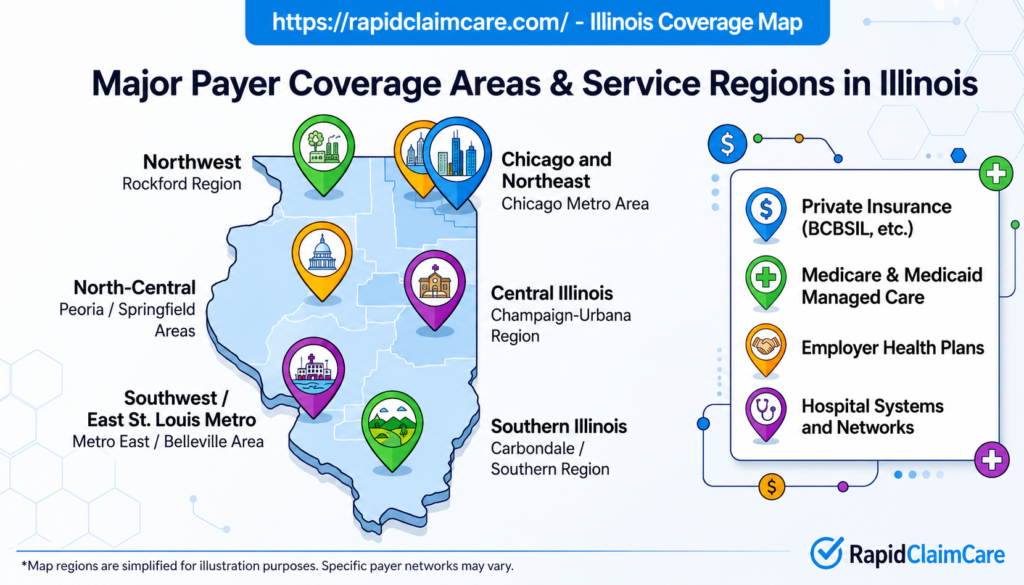
See how this plays out practice-wide on our Illinois medical billing services page, including which payers and MCOs we work with directly across the state.
Primary care claim denials run higher than most practices realize. Industry benchmarks put average denial rates for primary care in the 5–10% range, well below the 85–90% first-pass acceptance rate most practices settle for as “normal.” Every denial also costs staff time to rework, so the real cost is higher than the unpaid claim amount alone.
Days in AR creep up fast without dedicated follow-up. A healthy family practice should have around 30–40 days in AR. Once staff gets stretched—which happens constantly in small practices—that number drifts to 50 or 60 days, and claims older than 90 days become dramatically harder to collect.
In-house billing is expensive to staff and hard to keep staffed. A single experienced medical biller in Illinois often costs 45,000–60,000 a year in salary alone, before benefits, software, and training. When that person leaves, claims stall for weeks while you hire and train a replacement.
Patient self-pay is a growing headache. As high-deductible health plans spread, more of your revenue depends on collecting directly from patients.
Under-billing is quieter than denials but just as costly. A CCM-eligible patient who never gets billed just doesn’t get billed. Nobody flags it because there’s nothing to flag—most practices unknowingly leave 15–25% of collectible revenue on the table every year, not from low volume, but from process gaps like this one.
Our AR recovery services and denial management team are built specifically around closing these two gaps—aging claims and reworked denials both get worked on within 72 hours of being flagged.
Days in AR creep up fast without dedicated follow-up. A healthy family practice should have around 30–40 days in AR. Once staff gets stretched—which happens constantly in small practices—that number drifts to 50 or 60 days, and claims older than 90 days become dramatically harder to collect.
In-house billing is expensive to staff and hard to keep staffed. A single experienced medical biller in Illinois often costs 45,000–60,000 a year in salary alone, before benefits, software, and training. When that person leaves, claims stall for weeks while you hire and train a replacement.
Patient self-pay is a growing headache. As high-deductible health plans spread, more of your revenue depends on collecting directly from patients.
Under-billing is quieter than denials but just as costly. A CCM-eligible patient who never gets billed just doesn’t get billed. Nobody flags it because there’s nothing to flag—most practices unknowingly leave 15–25% of collectible revenue on the table every year, not from low volume, but from process gaps like this one.
Our AR recovery services and denial management team are built specifically around closing these two gaps—aging claims and reworked denials both get worked on within 72 hours of being flagged.
There’s no universal answer—it depends on practice size and payer mix.
Solo and small group practices (1–5 providers) usually don’t have the claim volume to justify a full-time dedicated biller, let alone a backup for when that person is out. Outsourced medical billing Illinois providers tend to make the most financial sense here since you’re paying a percentage of what’s actually collected rather than a fixed salary regardless of output.
Mid-sized multi-provider practices often do best with a hybrid model: front-desk staff handle eligibility verification and patient collection at the point of service, while claims submission, denial management, and AR follow-up get outsourced to a team that does it full-time.
Community health clinics and FQHCs face a different calculus — a heavier Medicaid mix, sliding fee scale billing, and grant reporting requirements layered on top of standard claims. This calls for a partner with specific FQHC/community health experience, not just general family medicine RCM experience.
On cost: outsourced billing services typically run 3–8% of collections, depending on practice size and claim complexity—compare that against the fully loaded cost of an in-house biller (salary, benefits, software, training, and turnover), and for many small-to-mid practices, outsourcing comes out ahead once you factor in the revenue recovered from better denial management and CCM/TCM capture. Rapid ClaimCare charges performance-based pricing within that range, with no setup fees and no long-term contracts — you pay when claims get paid.
Before signing with any physician billing services Illinois provider, ask these questions directly:
Red flags: pricing that stays vague until you sign, no mention of Illinois-specific payer experience, and no sample reports available before you commit.

→ Get a free revenue audit of your last 90 days of claims. Rapid ClaimCare reviews your first-pass acceptance rate, denial rate by reason code, days in AR, and underpayment rate per payer and delivers a written report with specific findings within 48 hours—on sales pitch, no commitment. Book your free consultation →
Rapid ClaimCare is a U.S.-based medical billing company staffed by AAPC- and AHIMA-credentialed coders, HIPAA-trained billing specialists, and RCM experts, serving independent practices, group clinics, and community health organizations — including family practices across Illinois. Clients typically see a 98.7% claims approval rate and clean claims submitted within 24 hours of encounter documentation, with denials worked within 72 hours rather than sitting in a queue. Onboarding takes 5–7 business days, starting with a free revenue audit and running in parallel with EHR integration, BAA signing, and payer enrollment review — so there’s no billing gap during the switch. Every engagement includes a signed Business Associate Agreement, 256-bit AES-encrypted data handling, and quarterly third-party HIPAA compliance audits.
As one family physician client put it, outsourcing let them focus fully on patient care while reimbursements started arriving faster than before—the kind of result independent practices are usually chasing when they start looking at billing vendors in the first place.
How much do medical billing services cost for a family practice? Most outsourced billing companies charge a percentage of collections, typically 3–8%, depending on practice size, claim volume, and complexity. Rapid ClaimCare uses transparent, performance-based pricing with no setup fees and no long-term contracts — you pay only when claims get collected.
What’s the average rate of primary care claim denials? Industry benchmarks generally put primary care denial rates around 5–10%, and average first-pass claim acceptance around 85–90%. A well-run billing operation with strong front-end eligibility checks and clean claim scrubbing can push both numbers meaningfully better—Rapid ClaimCare clients typically see 97%+ first-pass acceptance.
How is HFS Medicaid billing different from commercial payers? HFS has its own payer IDs, timely filing windows, and claim submission requirements, and most Illinois Medicaid patients are actually enrolled in a managed care plan—like Meridian, Molina, or CountyCare—rather than billed straight through HFS, each with its own rules.
Can a small practice bill for chronic care management (CCM)? Yes, practice size isn’t a barrier to CCM billing. What’s usually missing is a system to identify eligible patients and track the required non-face-to-face care time each month, which is where most small practices fall short, not eligibility itself.
How long does it take to switch billing companies without disrupting cash flow? With a well-managed transition, expect 5–7 business days for full onboarding, with overlap between billing teams so claims already in process don’t fall through the cracks. Ask any prospective vendor how they specifically handle that overlap before you sign.
Does modifier -25 really cause that many denials for wellness visits? Yes—it’s one of the most common denial triggers in primary care specifically because AWVs and problem-oriented visits happen together so often. The fix isn’t avoiding the combination; it’s documenting the problem-oriented portion clearly enough to justify billing both.
What happens if my practice bills VFC-supplied vaccines incorrectly? Billing for the vaccine itself when it was VFC-supplied (rather than just the administration fee) is a compliance issue, not just a denial risk. A biller with VFC program experience will flag this automatically.
Do I need a different billing vendor if I’m an FQHC or community health clinic? Not necessarily a different vendor, but definitely one with specific FQHC/community health experience—sliding fee scales, grant reporting, and a heavier Medicaid mix all require billing knowledge a standard commercial-focused biller may not have.
What reports should I expect to receive from a billing service? At minimum: a denial report showing what’s being denied and why, an AR aging report, and a monthly collection rate summary. If a vendor can’t show you sample reports before you sign, ask why.
Is it worth outsourcing billing if my practice already has low denial rates? Often yes—low denials don’t necessarily mean you’re capturing everything you’re entitled to bill. CCM, TCM, and wellness-visit coding gaps are common even in practices with clean claim submission, since under-billing doesn’t show up as a denial at all.
Ready to see where your practice’s revenue might be leaking? Get your free revenue audit — a written report within 48 hours, no commitment.