Cybercrime isn’t just rising, it’s accelerating faster than most healthcare businesses are prepared for.
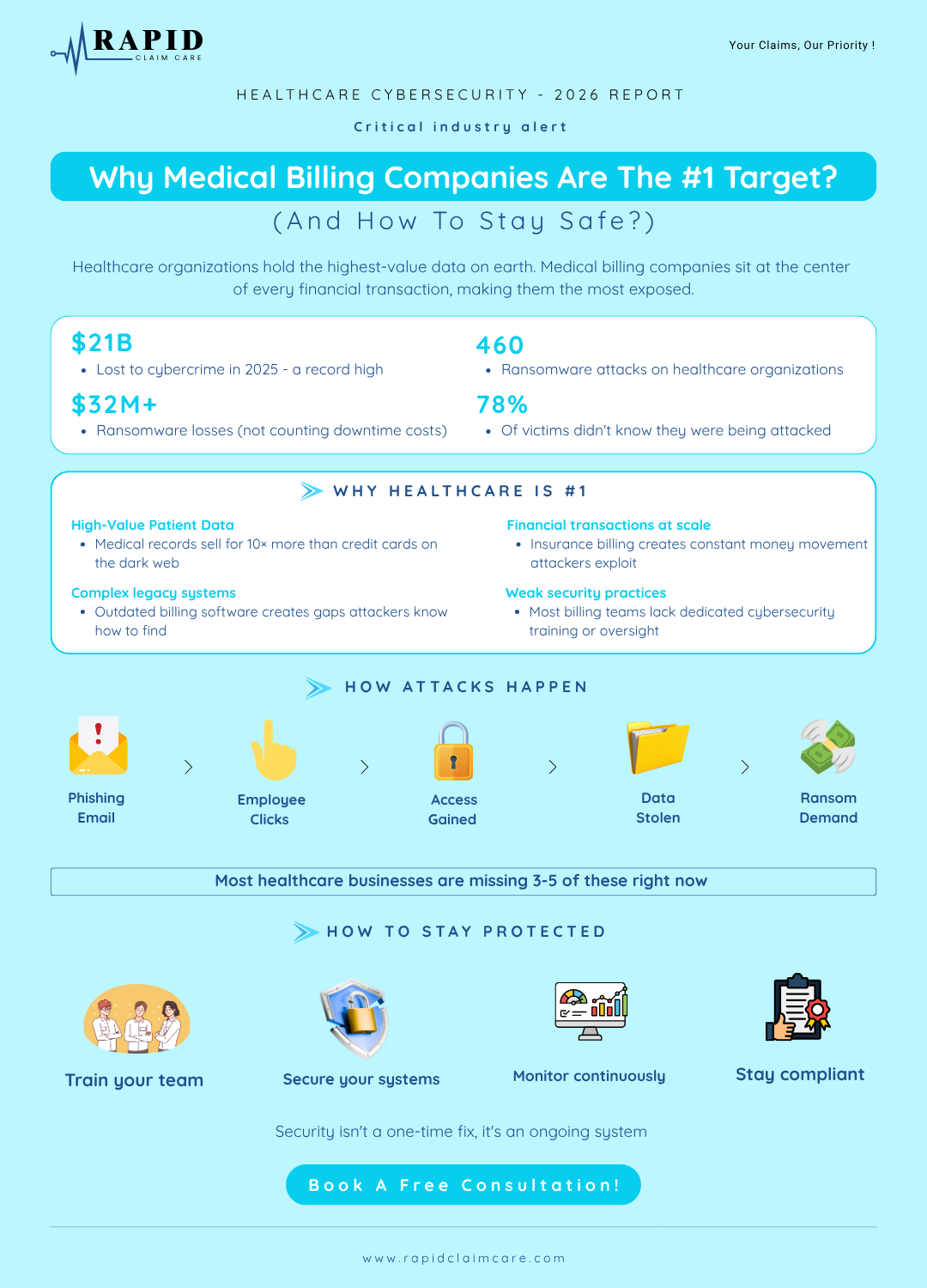
The numbers make that clear. In 2025 alone, losses were driven heavily by:
These aren’t isolated incidents, they reflect a rapidly evolving threat landscape targeting data-rich industries.
And if you’re involved in medical billing, revenue cycle management, or handling patient data in any capacity, this isn’t distant news, it directly impacts your operations, revenue, and risk exposure.
At Rapid Claim Care, we’ve been tracking this shift closely, because when you look at the data, one thing becomes obvious:
Healthcare businesses can no longer afford to treat cybersecurity as an afterthought.
Healthcare is the #1 most targeted industry for cyberattacks
Cybercrime losses reached nearly $21 billion in 2025
Over 1 million cybercrime complaints were reported in a single year
Phishing and email-based attacks remain the most common entry point
78% of victims don’t realize they’re being scammed
Medical billing companies are high-risk due to financial + patient data access
Ransomware and data breaches can disrupt operations and damage trust
Basic security practices prevent the majority of attacks
Ongoing compliance and monitoring are essential, not optional
Let’s start with the reality most practices underestimate:
Healthcare and public health sectors are now the most targeted industries for cyberattacks.
In just one year:
That’s not a random spike, it’s a clear signal.
Attackers go where the data is valuable, systems are complex, and security gaps are common.
Healthcare checks all three boxes.
In 2025 alone:
Source : FBI crime report 2025
And here’s the stat that should concern every healthcare provider:
78% of victims didn’t even realize they were being scammed.
This isn’t just about large hospitals or enterprise systems.
Small clinics, billing companies, and independent practices are often easier targets.
At Rapid ClaimCare, we see this every day.
Medical billing companies sit at the intersection of:
That makes them incredibly valuable, and incredibly vulnerable.
Even a small breach can lead to:
And unlike other industries, healthcare doesn’t just lose money, it loses trust.

Most cyberattacks don’t happen because systems are too weak.
They happen because the basics are ignored.
The organizations that stay secure aren’t doing anything magical, they’re just consistent.
At Rapid Claim Care, we focus on a few core principles:
Because prevention isn’t a one-time task,it’s a process.
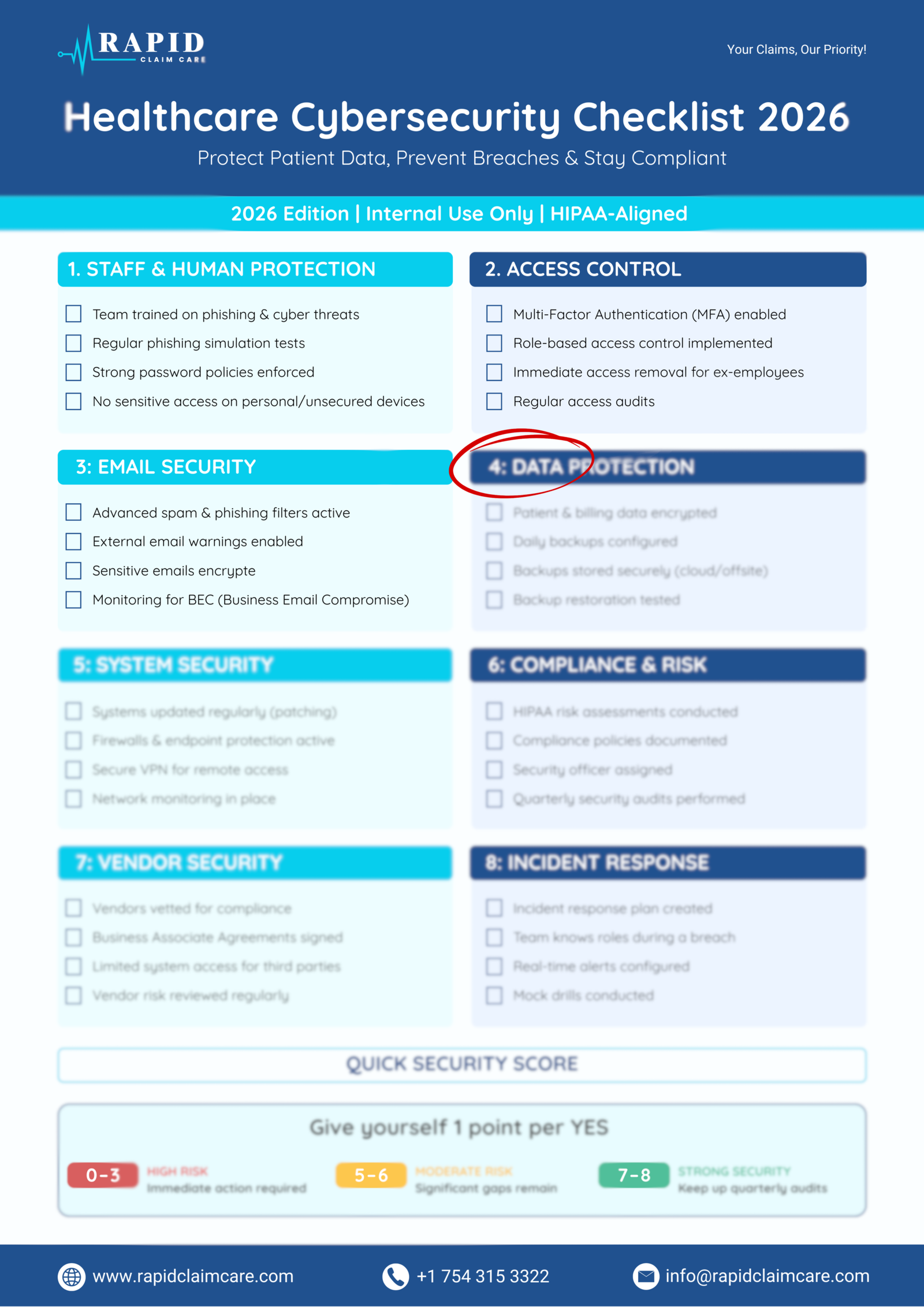
If you’re running a clinic or billing operation, here’s a quick reality check.
How many of these are actually in place?
✔ Staff trained to identify phishing emails
✔ Multi-factor authentication (MFA) enabled across systems
✔ Regular data backups (tested, not just scheduled)
✔ Role-based access controls (not everyone sees everything)
✔ Encrypted communication channels
✔ Ongoing compliance monitoring (not just at audit time)
✔ Incident response plan (clear steps if something goes wrong)
✔ Third-party vendor security checks
Most businesses assume they’re covered, until they’re not.
Cybercrime isn’t slowing down.
It’s evolving, fast.
And in healthcare, where the stakes are higher, the margin for error is smaller.
At Rapid Claim Care, we believe growth should never come at the cost of security.
Because in today’s landscape:
The question isn’t if healthcare businesses will be targeted,
It’s whether they’re prepared when it happens.
If you’re handling medical billing, patient data, or insurance workflows, now is the time to look at your systems more closely.
Because the businesses that win in 2026 won’t just be the ones that grow,
They’ll be the ones that grow securely.
Get a free billing audit and find out if your practice has security gaps putting your revenue and compliance at risk.
78% of healthcare businesses don't realize they're being targeted, until it's too late.

Saad Ahmed Turk is a ROI-driven Healthcare SEO and Growth Strategist helping clinics and service-based healthcare businesses scale through AI-powered search marketing. As Head of Marketing & Growth at RCC, he builds and optimizes scalable systems using SEO, AEO, GEO, automation, and AI tools like GoHighLevel to drive consistent patient acquisition and revenue growth.
Healthcare organizations store sensitive patient and financial data, making them highly valuable targets with often complex and vulnerable systems.
Cybercrime losses reached nearly $21 billion, making it the highest recorded year for digital fraud and attacks.
Phishing, ransomware, business email compromise (BEC), and data breaches are the most common threats affecting healthcare organizations.
They handle both financial transactions and patient data, making them prime targets for cybercriminals seeking high-value information.
By implementing staff training, secure email systems, multi-factor authentication, regular audits, and compliance monitoring.
Yes, strong cybersecurity practices are essential for maintaining compliance with regulations and avoiding penalties or data breaches.
Assuming basic protections are enough and delaying proactive security measures until after an incident occurs.