Inside you will find:
Don’t let billing headaches slow your business growth. Take 5 minutes to protect your revenue.
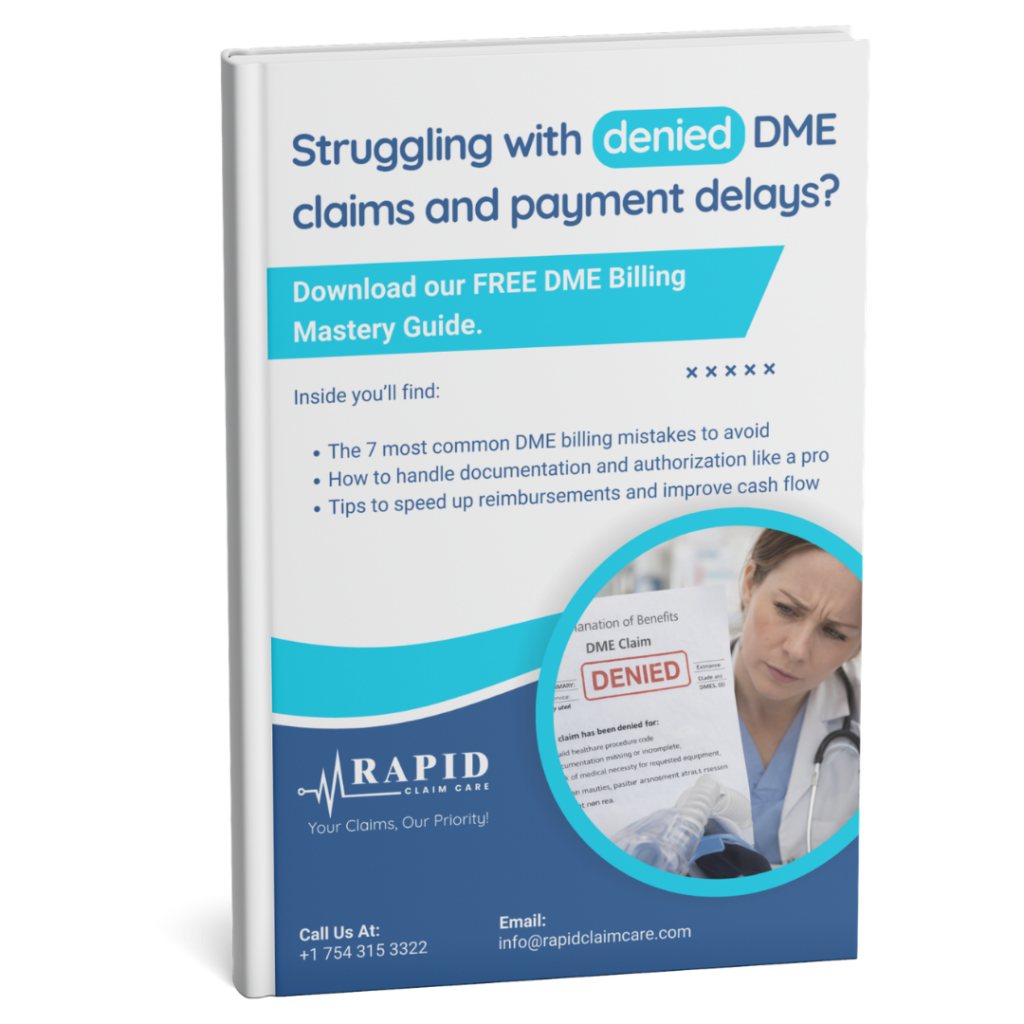
Durable Medical Equipment (DME) providers face some of the toughest billing challenges in healthcare. From confusing HCPCS codes to strict documentation, prior authorizations, and payer audits, even minor mistakes can delay or deny payments.
This DME Billing Success Blueprint is designed to help you:
Whether you manage billing in-house or work with a service, this guide is your roadmap to smoother revenue cycles and less administrative stress.





Your DME business deserves a billing system that protects your revenue while you focus on patient care. Use this blueprint to
Don’t let billing headaches slow your business growth. Take 5 minutes to protect your revenue.
Contact Rapid Claim Care for a free DME billing consultation today!
The most common DME billing mistakes include incorrect HCPCS codes, incomplete documentation, missing prior authorizations, ignoring payer-specific rules, and failing to follow up on submitted claims. For Durable Medical Equipment providers, even small coding or documentation errors can trigger denials from payers like Centers for Medicare & Medicaid Services (CMS). Common issues include: Using the wrong HCPCS Level II code - Missing Certificates of Medical Necessity (CMNs) - Incomplete physician orders - Failure to meet payer-specific documentation requirements - Late claim tracking and follow-ups Proactively auditing claims and using a pre-submission checklist can significantly reduce denial rates and accelerate reimbursements.
DME providers can reduce claim denials by strengthening documentation, verifying eligibility before submission, securing prior authorizations, and implementing a structured claim review process. Key strategies include: Verifying patient eligibility and benefits upfront - Confirming correct HCPCS coding - Ensuring medical necessity documentation is complete - Tracking authorizations before equipment delivery - Monitoring claims weekly until payment is received Providers who implement standardized billing workflows often see faster reimbursement cycles and fewer rework hours. A structured DME billing checklist helps ensure claims are clean before submission.
DME billing typically requires a detailed physician order, proof of medical necessity, accurate HCPCS codes, delivery confirmation, and payer-specific documentation. For compliance with Medicare and commercial insurers, providers must maintain: Signed physician prescriptions - Certificates of Medical Necessity (when required) - Face-to-face encounter documentation (if applicable) - Proof of delivery records - Detailed patient medical records Incomplete or inconsistent documentation is one of the top triggers for audits and recoupments. Maintaining organized and audit-ready files protects revenue and reduces compliance risks.
Prior authorizations are critical in DME billing because many payers require approval before equipment is dispensed. Failure to obtain authorization can result in automatic claim denial. Many policies under Medicaid and commercial insurers require pre-approval for higher-cost equipment such as power wheelchairs, CPAP devices, and orthotics. Best practices include: - Verifying authorization requirements per payer - Submitting complete documentation with the request - Tracking approval timelines - Confirming authorization numbers before claim submission Using a pre-authorization checklist reduces preventable denials and protects cash flow.
A DME billing checklist improves revenue cycle management by standardizing processes, minimizing human error, and ensuring every claim meets payer requirements before submission. A structured checklist helps teams: Catch coding errors early - Verify documentation completeness - Confirm authorization approvals - Track submission and follow-up dates - Identify denial trends For DME suppliers, consistent internal controls lead to fewer denials, faster reimbursements, and stronger financial stability. Downloading a free DME billing checklist can provide a practical framework to implement these improvements immediately.