
By the Rapid ClaimCare Billing Team — certified medical billing and revenue cycle specialists serving healthcare providers across the U.S., including Washington State.
Claim denial management Washington is essential for medical practices that want to reduce rejected claims, recover lost revenue, and maintain a healthy cash flow. Effective denial management helps healthcare providers identify the causes of claim denials, correct billing issues, and prevent similar problems from occurring in the future.
If you run an independent family medicine practice, a small group, or a community health clinic in Washington, you already know this feeling: the visit happened, the documentation was solid, and the claim went out clean—and it still came back denied. Multiply that by a few dozen claims a month and you’re not just losing time. You’re losing money you already earned.
That’s exactly the gap that medical claim denial management services in Washington are built to close. This guide walks through why denials happen more often here than in most states, what they’re actually costing your practice, and how a real denial management process — whether you build it in-house or bring in outside help — turns that leak into recovered revenue.
Claim rejection vs. denial management—these two terms get used interchangeably, but they’re not the same problem, and mixing them up wastes staff time.
A rejection happens before a claim is ever processed. It bounced back for a typo, a missing modifier, or a mismatched patient ID—it never reached the payer’s adjudication system. A denial is different: the payer received the claim, reviewed it, and made a decision not to pay. That’s the one that needs an actual appeal, real documentation, and a deadline you cannot miss.
Medical claim denial management services in Washington exist to handle both sides of this—fixing the workflow issue causing repeat rejections and recovering the revenue on claims that were denied outright. It’s one of the highest-leverage pieces of healthcare revenue cycle management, because unlike most RCM work, denial management directly recovers money that’s already been earned, not just money that’s owed.
Here’s where Washington genuinely gets more complicated than most states. If your practice sees Apple Health (Washington Medicaid) patients, you’re not billing one Medicaid program — You’re billing through one of five separate managed care organizations, each running its own prior authorization list, claim edits, and appeal portal: Coordinated Care, Community Health Plan of Washington (CHPW), Molina Healthcare of Washington, UnitedHealthcare Community Plan of Washington, and Wellpoint Washington (formerly Amerigroup). A prior auth rule that applies under Molina for a given CPT code might not apply under CHPW for the exact same code. Your front desk and billing staff are effectively managing five separate rulebooks for Medicaid alone, on top of Premera, Regence, Kaiser WA, and Medicare.
Most national billing content skips this entirely. It’s exactly why a generic approach to denial management underperforms for practices here—and why our own Washington medical billing services are built around this state’s specific payer mix rather than a one-size-fits-all national playbook.
A few things stack specifically for practices in this state:
Industry-wide, denial rates typically fall somewhere between 5% and 15% of submitted claims, with strong performers keeping first-pass acceptance above 90%. Practices juggling multiple Apple Health MCOs without a dedicated tracking system tend to land on the higher end — not because their coding is worse, but because there’s simply more to track correctly.
Roughly in the order we see them come up:
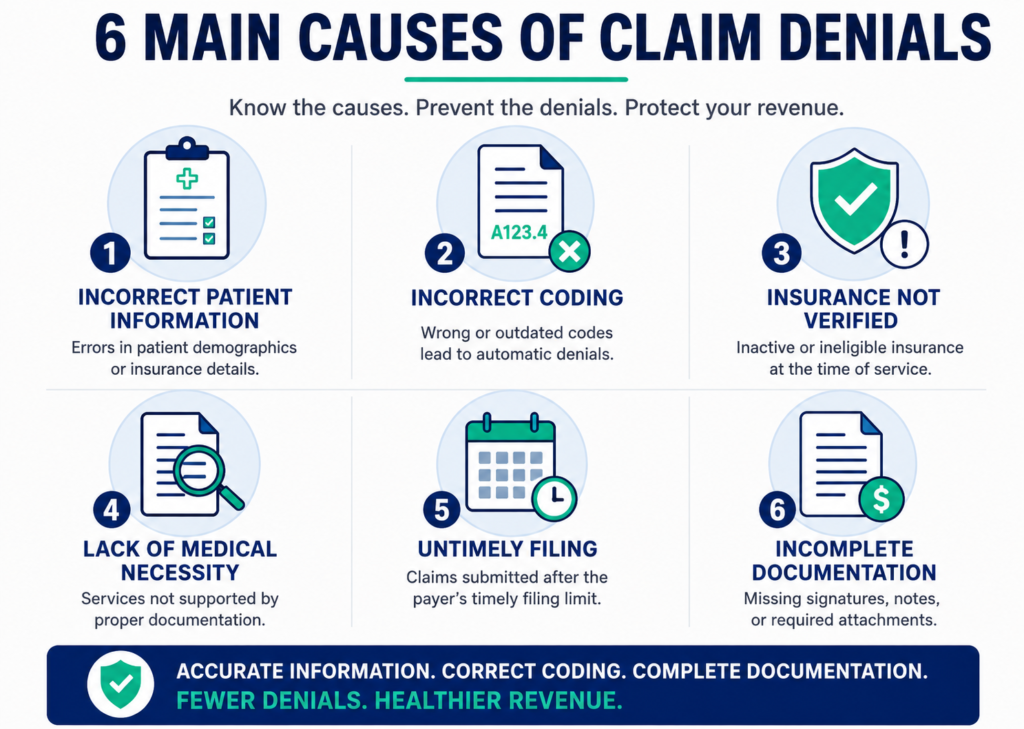
Eligibility and coverage verification failures. The single most common and most preventable cause, especially with Apple Health churn. A patient with active Molina coverage in March might be on CHPW — or uninsured — by June. This is why eligibility and benefits verification before every visit, not just the first one, matters so much.
Missing or expired prior authorizations. Especially for imaging, specialty referrals, and certain procedures. Each MCO’s prior auth list differs slightly, so a code that clears without issue for a UnitedHealthcare Community Plan patient might require authorization under Coordinated Care.
Coding errors and mismatched modifiers. This is where medical coding accuracy and billing compliance in Washington practices most often break down—wrong or missing modifiers, unbundled codes, or a diagnosis that doesn’t clearly support the billed procedure.
Timely filing violations. Every payer sets its own filing deadline, and they’re not aligned. Miss it, and the claim is denied with no appeal option — the single most frustrating category, because it’s entirely avoidable and entirely unrecoverable once it happens.
Medical necessity denials. The payer processed the claim but disagrees the service was necessary based on what was submitted. Usually, it’s a documentation gap, not a clinical one—the care was appropriate, but the chart note didn’t make the case clearly enough for the payer’s review criteria.
Coordination of benefits (COB) errors. Billing the secondary payer first or missing that a patient has dual Medicare/Medicaid coverage. Common in Washington’s older rural population.
Here’s a straightforward way to see it. A two-physician family practice submitting 800 claims a month at a 12% denial rate — not unusual without a formal tracking system — generates roughly 96 denied claims monthly. If even a third of those go unworked past the appeal deadline because nobody had the bandwidth to chase them, that revenue isn’t delayed. It’s gone.
For a hospital system, that’s a rounding error. For an independent practice running on thin margins, it’s the difference between hiring the medical assistant you need this year and pushing it another twelve months. It’s also consistent with what shows up industry-wide: most healthcare practices unknowingly leave somewhere between 15% and 25% of collectible revenue uncollected every year—not because of low claim volume, but because of process gaps exactly like these.
There’s a slower cost too, easy to overlook: staff burnout. Billing staff stuck reworking denials instead of doing proactive eligibility checks are locked in a reactive loop — and that loop tends to produce more denials, not fewer, because nobody has time left to fix what’s actually causing them.
A real insurance claim appeals process for providers isn’t “resubmit and hope.” It’s a repeatable cycle:
This is the exact workflow our denial management team runs for every client — denials are categorized and appeal prep begins within 72 hours of receipt, so nothing sits long enough to risk a missed deadline.
Appeals recover money you’ve already lost. Prevention keeps you from losing it in the first place, and it’s a lot cheaper.
This depends on your size and situation, not a one-size answer.
A solo or two-physician independent practice often can’t justify a dedicated denials FTE but also can’t afford to let denials sit unworked. This is usually where medical billing outsourcing on a percentage-of-collections model makes sense—you pay only for what gets recovered, with no setup fees or long-term contract locking you in.
A community health clinic with a heavy Apple Health population faces a different problem: high volume, thin administrative margins, and five-MCO complexity. Here, the value of outsourcing comes less from raw appeal-writing capacity and more from a partner who already knows each MCO’s rules cold.
A larger group practice with an existing billing team might just need targeted support—someone to clear an aged accounts receivable backlog or handle appeals for one particularly difficult payer, while keeping day-to-day billing in-house.
Signs it’s time to bring in outside help, regardless of size: your denial rate is climbing past benchmark, AR days are stretching past 45–60, you have an appeals backlog nobody’s had time to work, or there’s simply no one whose job it is to own this.
If you do look for a partner, the real question isn’t whether they offer denial management — nearly everyone says yes. It’s whether they actually know Washington’s payer landscape: the five Apple Health MCOs, Premera’s and Regence’s commercial rules, and how the OIC’s external review process works. Ask directly about their first-pass acceptance rate, how quickly denials get worked after receipt, and whether they sign a Business Associate Agreement (BAA) as standard practice, not an add-on.
This is the payoff, and it’s worth being concrete about how it actually shows up:
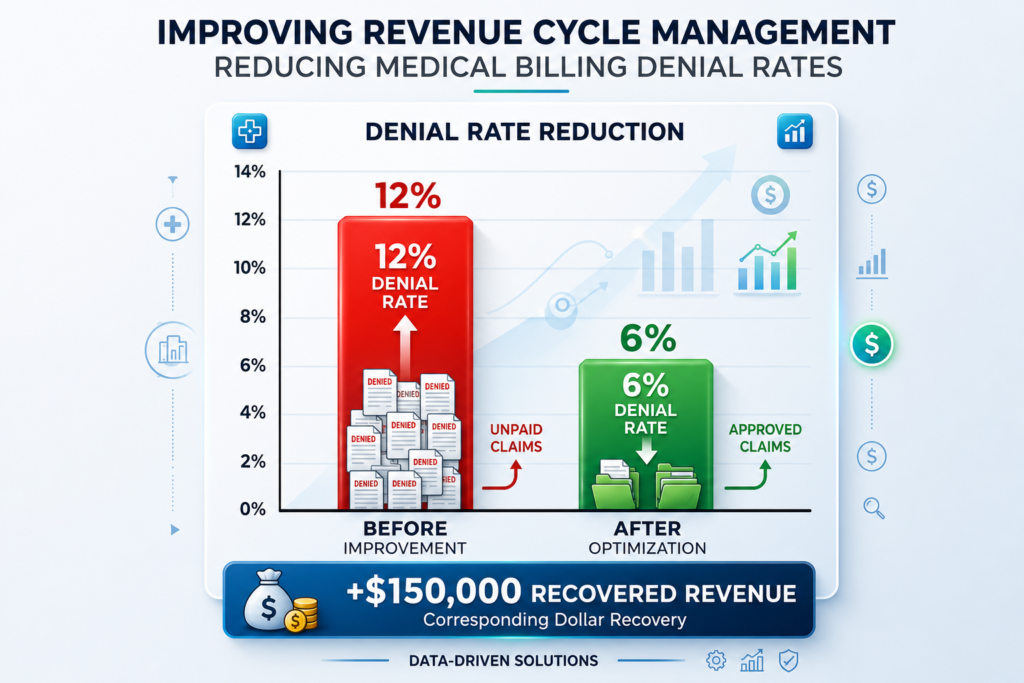
A practice moving from a 12% denial rate to 6%, on 800 claims a month at an average reimbursement of $150, recovers roughly $7,200 a month that it was previously leaving on the table. That’s not a marketing number — it’s the math of fixing a leak, and it’s the kind of gap our free revenue audit is built to find in your own claims data within 48 hours.
Not sure where your practice’s denial rate actually stands? Rapid ClaimCare’s free revenue audit reviews your first-pass acceptance rate, denial rate by reason code, and average days in AR — no obligation, just a clear picture of what’s being left on the table. Get your free revenue audit →
What’s the difference between a claim denial and a claim rejection? A rejection never reaches the payer’s processing system — it bounces back for a technical error like a missing ID or invalid code. A denial is fully processed and formally refused, which means it needs an appeal, not just a resubmission.
How long do I have to appeal a denied claim in Washington? It depends on the payer. Timely filing and appeal windows vary between Medicare, each Apple Health MCO, and each commercial carrier, so always confirm the current deadline in that payer’s provider manual rather than relying on a general rule.
Does Apple Health have different appeal rules than commercial insurers? Yes. Each of the five Apple Health MCOs runs its own appeal process and portal, separate from how you’d appeal with Premera, Regence, or another commercial payer. Fully insured commercial disputes can also be escalated to Washington’s Office of the Insurance Commissioner after internal appeals are exhausted.
Can small practices afford outsourced denial management? Usually yes, since most outsourced denial management is priced as a percentage of what’s actually recovered—the cost scales with the revenue it brings back rather than sitting on your books as fixed overhead. There’s typically no setup fee and no minimum claim volume required.
What denial rate should my practice be targeting? Under 5% is considered strong industry-wide. Consistently above 10–12% is worth investigating — not necessarily a crisis, but a real, recoverable opportunity.
How is a medical necessity denial different from a coding denial? A coding denial means something was wrong with how the claim was submitted—a modifier or a code pairing. A medical necessity denial means the payer processed the claim correctly but disagrees the service was warranted based on the documentation. The fix for the second one is almost always better chart documentation, not resubmission.
Do all five Apple Health MCOs use the same prior authorization list? No. Coordinated Care, CHPW, Molina, UnitedHealthcare Community Plan, and Wellpoint Washington each maintain their own prior authorization requirements, and a code that’s exempt under one plan may require authorization under another for the same service.
What happens if my practice misses a payer’s timely filing deadline? In almost all cases, the claim is denied permanently with no appeal option. This is why deadline tracking has to be active and payer-specific — it’s the one denial category with zero recovery path once it happens.
Can a peer-to-peer review overturn a medical necessity denial? Often, yes. A peer-to-peer review lets your provider speak directly with the payer’s medical director to explain the clinical reasoning, and it frequently resolves what a paper appeal alone couldn’t.
How do I know if my practice needs outsourced help versus better internal training? If your denials cluster around one or two recurring, fixable causes—like a single payer’s timely filing rule—internal training often solves it. If denials are spread across many causes and your team doesn’t have time to work the backlog, that’s usually a sign outsourced support will pay for itself faster than internal fixes alone.
Still have questions about how this would apply to your practice specifically? Talk to a Rapid ClaimCare billing specialist →
Denial rate benchmarks, payer rules, and filing deadlines referenced above reflect general industry data and Washington Health Care Authority program details as of publication. Prior authorization requirements and appeal deadlines change — always confirm current rules directly with each payer or MCO before acting on them.