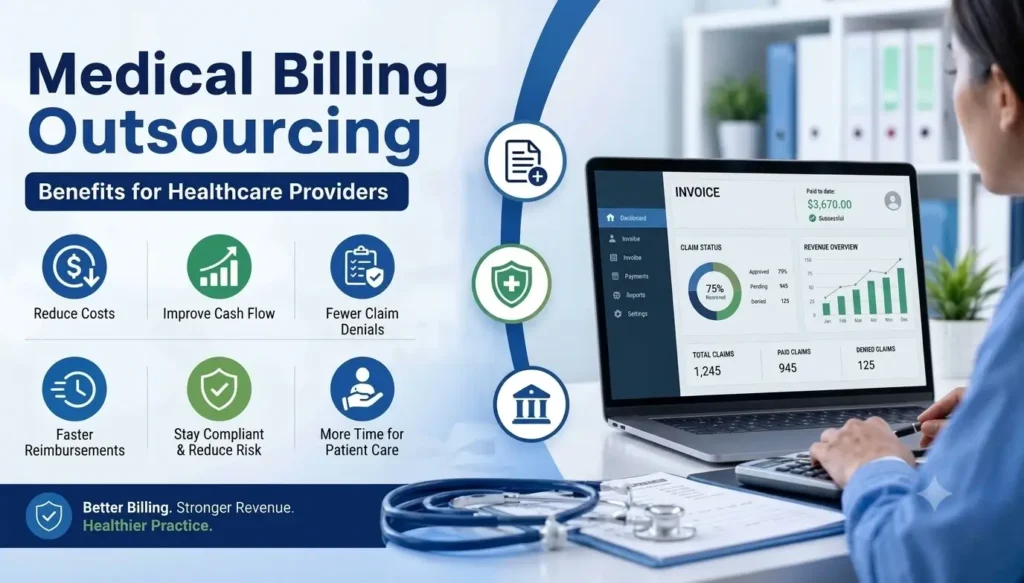
Healthcare providers dedicate countless hours to delivering quality patient care, yet many struggle with one persistent challenge medical billing. Between changing insurance policies, coding updates, claim denials, and administrative burdens, managing billing in-house can quickly become overwhelming. Even small billing mistakes can delay reimbursements, reduce cash flow, and create unnecessary stress for healthcare organizations.
Medical billing outsourcing has become a strategic solution for practices looking to improve financial performance while allowing physicians and staff to focus on what truly matters to patients. Instead of spending valuable resources on billing operations, providers partner with experienced billing professionals who specialize in maximizing reimbursements and maintaining compliance.
Whether you’re running a private practice, specialty clinic, urgent care center, or multi-location healthcare organization, understanding the benefits of outsourcing medical billing can help you make a more informed business decision. In this guide, you’ll discover how outsourcing medical billing improves revenue cycle performance, reduces operational costs, minimizes billing errors, and supports long-term growth without sacrificing patient satisfaction.
Why Medical Billing Is More Complex Than Ever
Healthcare billing isn’t just about sending claims to insurance companies anymore. Today’s healthcare providers must navigate evolving payer regulations, ICD-10 coding updates, CPT modifications, prior authorization requirements, and increasingly strict compliance standards.
One overlooked coding error can trigger claim denials that delay payments for weeks—or even months.
Healthcare organizations also face challenges like:
- Increasing administrative workload
- Staffing shortages
- Rising operational costs
- Frequent insurance policy changes
- Complex reimbursement models
- Higher patient payment responsibility
Managing all these responsibilities internally often stretches resources thin and affects overall practice efficiency.
This is one reason many providers choose Medical Billing Services to streamline billing operations while improving financial outcomes.
What Is Medical Billing Outsourcing?
Medical billing outsourcing refers to hiring a specialized third-party company to handle some or all aspects of the medical billing process.
These responsibilities typically include:
- Insurance verification
- Medical coding support
- Claim submission
- Payment posting
- Denial management
- Accounts receivable follow-up
- Patient billing
- Reporting and analytics
- Compliance monitoring
Instead of building and maintaining a large in-house billing department, healthcare providers leverage experienced professionals equipped with advanced billing technology and industry expertise.
The result is a smoother revenue cycle with fewer administrative headaches.
Top Medical Billing Outsourcing Benefits for Healthcare Providers
1. Improved Revenue Cycle Performance
One of the biggest advantages of outsourcing medical billing is a healthier revenue cycle.
Professional billing companies focus entirely on maximizing reimbursements. They monitor every stage of the billing process—from patient registration to final payment collection.
Because experienced billing specialists submit cleaner claims, providers often experience:
- Faster reimbursements
- Lower denial rates
- Reduced payment delays
- Improved cash flow
- Better collection performance
A stronger revenue cycle gives healthcare organizations greater financial stability and allows them to invest confidently in patient care and practice growth.
Healthcare providers looking to strengthen overall financial performance often combine outsourcing with Revenue Cycle Management Services for end-to-end optimization.
2. Fewer Claim Denials
Denied claims are among the most expensive problems in healthcare billing.
Industry studies consistently show that many claim denials result from preventable issues such as:
- Missing documentation
- Incorrect coding
- Eligibility errors
- Duplicate claims
- Authorization problems
Every denied claim requires additional staff time to investigate, correct, and resubmit.
Medical billing specialists implement quality control measures before claims are submitted, dramatically reducing avoidable errors.
Benefits include:
- Higher first-pass acceptance rates
- Reduced rework
- Faster insurance payments
- Lower administrative costs
Instead of constantly fixing mistakes, healthcare providers receive payments sooner and spend less time chasing outstanding claims.
3. Significant Cost Savings
Many healthcare providers assume outsourcing is expensive.
In reality, outsourcing often reduces overall operating costs.
Maintaining an internal billing department requires investments in:
- Employee salaries
- Payroll taxes
- Benefits
- Office space
- Billing software
- Training
- Compliance updates
- IT infrastructure
These expenses add up quickly.
Outsourcing converts many fixed expenses into predictable service costs while eliminating ongoing investments in staffing and technology.
Healthcare organizations also avoid costs associated with employee turnover, recruitment, and continuous training.
The financial savings can be redirected toward expanding services, purchasing new medical equipment, or improving patient experiences.
4. Access to Billing Experts
Medical billing regulations change constantly.
Insurance carriers frequently update reimbursement policies, coding requirements, and documentation standards.
Keeping internal staff fully trained requires continuous education.
Outsourcing gives healthcare providers immediate access to experienced professionals who stay current with:
- CPT updates
- ICD-10 revisions
- HCPCS changes
- CMS guidelines
- HIPAA compliance
- Commercial payer policies
These specialists understand complex billing scenarios across multiple specialties, reducing errors while improving reimbursement accuracy.
Practices that require specialized coding assistance often benefit from integrating Medical Coding Services alongside outsourced billing operations.
5. More Time for Patient Care
Administrative work continues to increase across the healthcare industry.
Physicians and office staff often spend hours managing insurance paperwork instead of focusing on patients.
Medical billing outsourcing removes much of this burden.
Instead of handling:
- Claims
- Appeals
- Follow-ups
- Insurance calls
- Payment posting
- Reporting
Staff members can dedicate more time to:
- Patient communication
- Appointment scheduling
- Clinical support
- Care coordination
- Practice improvement
Patients notice the difference when front-office staff have more availability and fewer administrative distractions.
Improved patient satisfaction frequently translates into stronger patient retention and better online reviews.
6. Better Compliance and Reduced Risk
Healthcare billing is heavily regulated.
Non-compliance can result in:
- Payment delays
- Financial penalties
- Audits
- Legal complications
- Reputation damage
Professional billing companies invest heavily in compliance management.
Their teams continuously monitor:
- HIPAA requirements
- CMS updates
- Medicare regulations
- Medicaid policies
- Insurance documentation standards
Regular quality audits and compliance reviews help reduce billing risks while protecting sensitive patient information.
Providers gain peace of mind knowing their billing operations follow current industry standards.
7. Faster Insurance Reimbursements
Cash flow is the lifeblood of every healthcare practice.
Delayed reimbursements create financial strain that affects staffing, equipment purchases, and operational planning.
Experienced billing professionals accelerate payment cycles by:
- Submitting claims promptly
- Tracking unpaid claims
- Following up with insurers
- Resolving denials quickly
- Correcting rejected claims immediately
The result is more predictable monthly revenue and healthier financial performance.
Instead of waiting months for reimbursement, providers often experience significantly shorter payment timelines.
8. Advanced Billing Technology Without Large Investments
Healthcare billing technology continues evolving.
Modern billing systems offer:
- Automated claim scrubbing
- Electronic claim submission
- Real-time reporting
- Analytics dashboards
- Denial tracking
- Performance monitoring
- Automated reminders
Purchasing and maintaining these systems internally can be expensive.
Outsourcing providers typically include advanced technology as part of their service, giving healthcare organizations access to enterprise-level tools without major capital investments.
These systems improve billing accuracy while providing valuable insights into financial performance.
9. Easier Scalability as Your Practice Grows
Growth is exciting—but it also creates new administrative challenges.
Adding physicians, expanding locations, or introducing new specialties often increases billing complexity.
Outsourced billing teams can scale alongside your organization without requiring immediate hiring or infrastructure expansion.
Whether your practice sees 500 claims per month or 50,000, experienced billing partners can adjust resources accordingly.
This flexibility supports sustainable growth while maintaining consistent billing performance.
10. Better Reporting and Financial Visibility
Successful healthcare organizations rely on accurate financial reporting.
Medical billing partners typically provide detailed performance reports covering:
- Collections
- Outstanding accounts receivable
- Denial rates
- Reimbursement trends
- Claim status
- Payer performance
- Revenue growth
These insights help providers identify opportunities to improve profitability and operational efficiency.
Rather than making decisions based on assumptions, healthcare leaders can rely on real financial data.
Healthcare organizations seeking deeper financial insights often strengthen reporting by implementing Healthcare Revenue Analytics Solutions.
How Outsourcing Impacts Different Healthcare Providers
Medical billing outsourcing isn’t limited to large hospitals. Providers of all sizes benefit from professional billing support.
Small private practices reduce administrative burdens while improving cash flow.
Multi-specialty clinics gain access to specialty-specific billing expertise that improves claim accuracy.
Urgent care centers benefit from faster claim processing due to high patient volumes.
Behavioral health providers, physical therapy clinics, chiropractic practices, and ambulatory surgery centers also experience significant improvements in reimbursement efficiency through outsourced billing.
Common Myths About Medical Billing Outsourcing
Despite its growing popularity, many healthcare providers hesitate to outsource because of common misconceptions. Understanding the facts can help you make a confident decision.
Myth 1: Outsourcing Means Losing Control
Many providers worry they’ll lose visibility into their billing process. In reality, reputable billing partners provide detailed dashboards, regular performance reports, and dedicated account managers. You’ll still have complete insight into claim status, collections, and financial performance.
Myth 2: It’s Only for Large Hospitals
Medical billing outsourcing benefits organizations of every size. Solo practitioners, family medicine clinics, specialty practices, urgent care centers, and multi-location healthcare groups all use outsourced billing to improve efficiency.
Myth 3: Outsourcing Costs More Than Hiring Staff
An in-house billing department involves salaries, benefits, software licenses, office space, compliance training, and employee turnover costs. Outsourcing often reduces overall expenses while improving collections and lowering claim denials.
Myth 4: Patient Experience Will Suffer
Professional billing companies focus on accurate patient statements, timely communication, and efficient payment processing. Many providers actually see higher patient satisfaction because their internal staff can spend more time assisting patients instead of handling billing tasks.
Signs Your Healthcare Practice Should Consider Outsourcing
If your practice faces any of the following challenges, outsourcing may be the right solution.
Increasing Claim Denials
When denial rates continue to rise despite internal efforts, it’s often a sign that billing processes need specialized expertise.
Slow Cash Flow
Waiting weeks or months for reimbursements can limit your ability to invest in staff, equipment, and patient services.
Growing Administrative Burden
If physicians or front-office staff spend more time handling billing than supporting patients, outsourcing can improve overall productivity.
Staffing Challenges
Recruiting and retaining experienced billing professionals has become increasingly difficult. Outsourcing eliminates many hiring and training concerns.
Expanding Practice Locations
Growth brings additional billing complexity. An experienced billing partner can scale operations without disrupting revenue.
Many growing organizations also strengthen operational efficiency by integrating Practice Management Solutions alongside outsourced billing.
How to Choose the Right Medical Billing Partner
Not every billing company delivers the same level of service. Choosing the right partner requires careful evaluation.
Look for a provider with proven experience in your medical specialty. Specialty-specific knowledge often leads to more accurate coding and higher reimbursement rates.
Ask about their technology platform. A modern billing system should include real-time reporting, electronic claim submission, denial tracking, and secure data management.
Verify compliance practices. Your billing partner should follow HIPAA regulations, maintain strong cybersecurity standards, and stay current with CMS and payer updates.
Request performance metrics such as average collection rates, first-pass claim acceptance rates, and denial percentages.
Transparent communication is equally important. Choose a partner that provides regular reporting, responsive support, and a dedicated account manager.
If credentialing is slowing reimbursements, consider connecting patients and providers through Provider Credentialing Services to support a smoother revenue cycle.
In-House Billing vs. Medical Billing Outsourcing
| Feature | In-House Billing | Outsourced Billing |
| Staffing Costs | High | Lower |
| Training Requirements | Continuous | Included |
| Software Investment | Expensive | Usually Included |
| Compliance Management | Internal Responsibility | Managed by Experts |
| Claim Accuracy | Depends on Staff Experience | Generally Higher |
| Revenue Cycle Efficiency | Moderate | Improved |
| Scalability | Limited | Highly Flexible |
| Technology Access | Additional Investment | Included |
| Administrative Workload | High | Significantly Reduced |
| Cash Flow | Can Be Inconsistent | More Predictable |
Best Practices for Successful Medical Billing Outsourcing
Outsourcing delivers the best results when healthcare providers remain actively involved in the partnership.
Define clear performance expectations before implementation. Establish measurable goals for collection rates, denial reduction, reimbursement timelines, and reporting frequency.
Maintain open communication through regular review meetings. Discuss performance trends, payer issues, and opportunities for improvement.
Provide complete and accurate clinical documentation. Even the best billing specialists rely on quality documentation to submit clean claims.
Monitor key performance indicators regularly, including:
- Days in Accounts Receivable
- First-pass claim acceptance rate
- Net collection rate
- Denial percentage
- Average reimbursement time
- Patient collection rate
Continuous collaboration creates stronger financial outcomes over time.
Future Trends in Medical Billing Outsourcing
Healthcare billing continues to evolve as technology reshapes revenue cycle management.
Artificial intelligence is helping identify billing errors before claims are submitted, reducing denials and improving reimbursement speed.
Automation streamlines repetitive tasks such as claim status tracking, payment posting, and eligibility verification.
Predictive analytics allows providers to identify revenue trends, forecast cash flow, and improve financial planning.
Cloud-based billing platforms enhance security while giving healthcare organizations real-time access to financial performance from anywhere.
As payer requirements become increasingly complex, outsourcing partners will continue investing in advanced technology that many individual practices cannot justify purchasing independently.
Organizations preparing for long-term growth often combine billing support with Healthcare Business Process Outsourcing (BPO) Services to streamline multiple administrative functions.
Frequently Asked Questions
Is outsourcing medical billing secure?
Yes. Reputable medical billing companies follow strict HIPAA regulations, implement secure data protection measures, and maintain compliance with healthcare privacy standards.
Does outsourcing reduce claim denials?
Yes. Experienced billing professionals review claims before submission, improve coding accuracy, and resolve documentation issues that commonly lead to denials.
Can small medical practices benefit from outsourcing?
Absolutely. Small practices often gain the greatest financial advantage by reducing staffing costs, improving cash flow, and allowing physicians to focus on patient care.
How quickly can outsourcing improve revenue?
Results vary by practice, but many providers notice improvements in claim acceptance rates, reimbursement speed, and collections within the first few months after implementation.
What healthcare specialties commonly outsource billing?
Primary care, family medicine, internal medicine, cardiology, orthopedics, dermatology, pediatrics, behavioral health, physical therapy, urgent care, chiropractic, and many other specialties successfully outsource medical billing.
Final Thoughts
Managing medical billing has become increasingly challenging as healthcare regulations, payer requirements, and reimbursement models continue to evolve. What once served as a back-office function now plays a direct role in the financial health of every healthcare organization. Medical billing outsourcing offers more than administrative support. It provides access to experienced billing professionals, advanced technology, improved compliance, and a stronger revenue cycle that helps practices thrive in a competitive healthcare environment.
By reducing claim denials, accelerating reimbursements, lowering operational costs, and allowing providers to focus on exceptional patient care, outsourcing becomes a strategic investment rather than simply an operational expense.
Whether you’re managing a small physician practice or a growing multi-specialty healthcare organization, the right billing partner can improve financial stability while positioning your practice for long-term success. If you’re evaluating ways to strengthen your revenue cycle, reduce administrative burdens, and improve operational efficiency, exploring Medical Billing Consultation Services is an excellent next step toward building a healthier, more profitable practice.