A DME claim can look perfect at first glance.
The HCPCS code is correct. The patient’s information is entered correctly. The equipment was delivered. The documentation is in the system.
So why did the claim still get denied?
Sometimes, the problem isn’t the equipment. It isn’t even the HCPCS code.
It is the modifier.
For DMEPOS suppliers, billing modifiers may look like two small characters attached to a claim, but those characters can communicate critical information about how an item should be processed. A modifier can tell the payer whether equipment is new or used, whether it is being rented, whether an item is being replaced, or whether particular coverage requirements have been met.
And when the wrong modifier is selected, a seemingly clean claim can become another denial for your billing team to investigate.
That is why understanding DME billing modifiers isn’t simply a coding exercise. It is part of building a cleaner, more accurate DME billing process.
In this guide, we’ll break down the most important DME modifiers, including KX, GA, GY, GZ, RR, NU, UE, RA, and RB, and explain why getting them right matters.
What Are DME Billing Modifiers?
Think of a HCPCS code as telling the payer what you’re billing.
A modifier adds another layer of information about the circumstances surrounding that item or claim.
For DMEPOS suppliers, modifiers can communicate information related to:
- Coverage requirements
- Medical necessity
- Rental equipment
- New equipment
- Used equipment
- Replacement equipment
- Replacement parts
- Expected claim denials
- Statutorily excluded items or services
This additional information helps the payer understand the claim beyond the basic HCPCS code.
The challenge is that modifiers are not interchangeable.
A modifier that is appropriate for a rental claim may be completely inappropriate for a purchase. Similarly, using a modifier simply because it is commonly associated with a particular piece of equipment can create problems if the individual claim does not support it.
The right modifier must match the actual circumstances of the claim.
Why Do DME Modifiers Matter So Much?
Here’s a question every DME supplier should ask:
How many claims are being delayed because of something that takes only a few characters to enter?
When a billing team handles hundreds or thousands of claims, small errors can become expensive problems.
Incorrect modifier usage can contribute to:
- Claim denials
- Payment delays
- Claim rework
- Documentation requests
- Incorrect reimbursement
- Increased administrative workload
- Compliance concerns
And there is another problem: modifier errors can sometimes be symptoms of a larger issue.
If the same modifier-related denial keeps appearing, the problem may not be one employee entering the wrong code. It could indicate a weakness in the organization’s coding procedures, documentation workflow, claim edits, or staff training.
That is why modifiers deserve more attention than simply checking a box before submission.
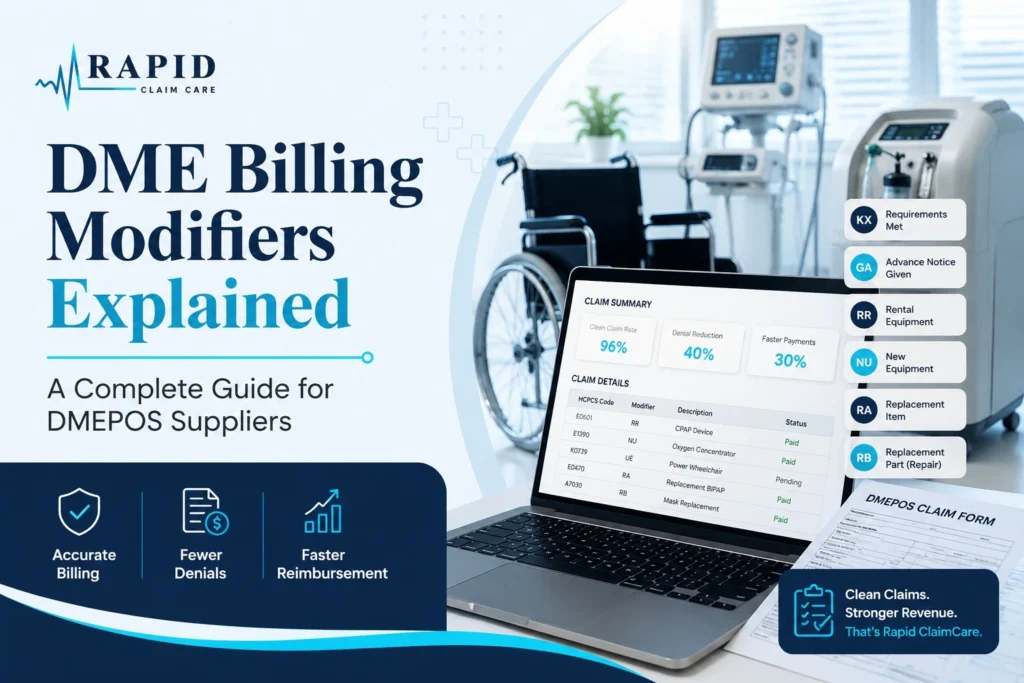
DME Billing Modifiers Cheat Sheet
Before diving deeper, here’s a quick reference to some commonly encountered DME modifiers:
| Modifier | General Purpose |
| KX | Indicates applicable requirements have been met |
| GA | Indicates an expected denial when an appropriate advance notice was issued |
| GY | Indicates an item or service that is statutorily excluded or does not meet the definition of a Medicare benefit |
| GZ | Indicates an expected denial when the required advance notice was not issued |
| RR | Indicates rental of equipment |
| NU | Indicates purchase of new equipment |
| UE | Indicates purchase of used equipment |
| RA | Indicates replacement of a DME item |
| RB | Indicates replacement of a part of a DME item furnished as part of a repair |
The table is useful as a starting point—but don’t stop there.
The real question isn’t “What does this modifier mean?”
It’s:
“Does this modifier accurately describe this specific claim?”
KX Modifier: When Coverage Requirements Matter
The KX modifier is one of the most important modifiers for DME billing.
In applicable situations, KX communicates that the relevant requirements have been met.
But here’s where suppliers need to be careful.
KX should never be treated as a shortcut to payment.
If the applicable coverage requirements are not supported by the patient’s records, simply adding KX does not solve the problem.
Before using KX, a billing team should consider whether the claim is supported by:
- Required medical documentation
- Applicable coverage criteria
- The treating practitioner’s documentation
- Appropriate orders
- Medical-necessity requirements
- Relevant utilization requirements
Imagine a supplier has a claim that looks ready to submit. Someone notices that KX is commonly used for that type of claim and adds it automatically.
The claim goes out.
Later, the documentation doesn’t support the applicable requirements.
That is not a modifier problem alone. It is a process problem.
The better approach is to connect modifier selection with documentation review.
GA vs. GZ: Two Modifiers You Shouldn’t Confuse
GA and GZ are easy to confuse—and that can create unnecessary billing headaches.
Both relate to situations where a denial is expected, but the circumstances surrounding the advance notice are different.
GA Modifier
The GA modifier is used when an expected denial is involved and an appropriate advance notice has been issued.
GZ Modifier
The GZ modifier is used when an item or service is expected to be denied and the required advance notice was not issued.
The distinction is important.
| Modifier | General Situation |
| GA | Expected denial + appropriate advance notice issued |
| GZ | Expected denial + required advance notice not issued |
Instead of memorizing the two letters, billing staff should understand the situation behind them.
That makes it easier to select the appropriate modifier when processing real claims.
GY Modifier: When Medicare Doesn’t Cover the Item
Not every medical item automatically qualifies as a Medicare benefit.
The GY modifier is associated with items or services that are statutorily excluded or do not meet the definition of a Medicare benefit.
For DME suppliers, understanding this distinction is important because an item can be medically related without necessarily being covered under the applicable Medicare benefit.
Before submitting a claim, the billing team should determine whether the item falls within the applicable benefit category and whether coverage requirements are satisfied.
The modifier should reflect the actual claim circumstance—not simply the supplier’s expectation of payment.
GZ Modifier: When a Denial Is Expected
The GZ modifier communicates another specific claim circumstance involving an expected denial.
It is particularly important to distinguish GZ from GA because the two modifiers do not communicate the same situation.
A billing team should review the circumstances surrounding the claim and applicable notice requirements before selecting the appropriate modifier.
This is one reason why modifier training should focus on real claim scenarios, rather than simply giving staff a list of abbreviations to memorize.
RR Modifier: DME Rental Billing
DME isn’t always purchased outright.
Many items are provided through rental arrangements, making the RR modifier particularly relevant to DME billing.
RR indicates that equipment is being rented.
But rental billing involves more than attaching RR to a claim.
Suppliers may need to track:
- Rental month
- Equipment history
- Beneficiary eligibility
- Applicable rental requirements
- Previous rental activity
- Documentation
- Replacement considerations
- Billing frequency
Rental claims can become especially complicated when billing teams lose track of where a beneficiary is within the applicable rental period.
A good billing process should make rental history easy to identify and review before claims are submitted.
NU Modifier: Is the Equipment New?
The NU modifier indicates that the equipment is being purchased as new equipment.
This sounds straightforward—but accuracy still matters.
The equipment status reported on the claim should correspond with the actual equipment being furnished.
If internal equipment records, inventory information, and claim information don’t match, the supplier can create unnecessary claim-processing problems.
A simple pre-submission verification can help:
Is the equipment actually new, and does the claim accurately reflect that status?
UE Modifier: When Used Equipment Is Furnished
The UE modifier indicates that used equipment is being purchased.
Again, the key principle is accuracy.
If used equipment is furnished, the claim should accurately represent that fact.
Suppliers should maintain appropriate records supporting the equipment status and make sure billing staff understand when UE may apply.
The difference between NU and UE may seem small, but it communicates very different information.
RA Modifier: Replacement DME
What happens when an existing DME item needs to be replaced?
That’s where the RA modifier becomes relevant.
RA indicates replacement of a DME item.
Replacement claims deserve careful attention because the supplier may need to establish why the original equipment is being replaced and whether applicable requirements are satisfied.
Before submitting a replacement claim, ask:
- Why is the equipment being replaced?
- Is replacement permitted under the applicable requirements?
- Is supporting documentation available?
- Does the beneficiary meet the relevant requirements?
- Does the claim correctly describe the replacement circumstance?
A replacement claim shouldn’t be treated exactly like a standard purchase claim.
The circumstances are different—and the billing should reflect those circumstances.
RB Modifier: Replacement Part During a Repair
Here’s another distinction that can easily be overlooked:
Replacing a DME item is not the same as replacing a part of that item.
The RB modifier is associated with replacement of a part of a DME item furnished as part of a repair.
This makes RA and RB particularly important to distinguish.
RA
Replacement of the DME item.
RB
Replacement of a part of the DME item as part of a repair.
For a billing team, understanding this difference can prevent the claim from communicating the wrong situation to the payer.
The Most Common DME Modifier Mistakes
Even experienced billing teams can encounter modifier problems.
Here are some of the mistakes worth watching.
1. Adding a modifier automatically
A modifier should describe the claim.
It shouldn’t be added simply because it is frequently used with a particular item.
2. Confusing GA and GZ
These modifiers involve different advance-notice circumstances.
A billing team should understand the distinction rather than relying on memory alone.
3. Confusing NU and UE
New equipment and used equipment are different claim circumstances.
The modifier should accurately represent what was furnished.
4. Confusing RA and RB
Replacing the entire DME item is different from replacing a component during a repair.
5. Using KX without adequate support
KX communicates that applicable requirements have been met. Documentation should support that statement.
6. Relying on outdated billing information
DME billing requirements can change.
A process that worked several years ago may not necessarily reflect current requirements.
That is why DME billing references and internal procedures should be reviewed regularly.
How Can DME Suppliers Improve Modifier Accuracy?
Better modifier accuracy doesn’t necessarily require a complicated system.
It starts with a consistent workflow.
Step 1: Confirm the HCPCS code
Make sure the equipment or supply is represented by the appropriate HCPCS code.
Step 2: Review the documentation
Check whether the documentation supports the claim and applicable requirements.
Step 3: Identify the claim circumstances
Is the equipment rented? New? Used? Being replaced? Is a part being replaced during a repair?
Step 4: Select the appropriate modifier
Choose the modifier that accurately represents those circumstances.
Step 5: Perform a pre-submission review
Look for inconsistencies before the claim reaches the payer.
Step 6: Monitor denials
Don’t simply correct individual denied claims.
Look for patterns.
If the same modifier-related issue appears repeatedly, investigate the underlying process.
DME Modifiers and the Bigger Denial Problem
A modifier is only one piece of the DME billing puzzle.
A claim can also run into problems because of:
- Incorrect HCPCS coding
- Missing documentation
- Medical-necessity issues
- Eligibility problems
- Prior authorization requirements
- Coverage limitations
- Incorrect rental information
- Inconsistent documentation
- Claim submission errors
This is why a strong DME denial management strategy looks beyond individual codes.
Instead of asking:
“How do we fix this denied claim?”
Ask:
“Why did this claim become a denial in the first place—and how do we stop the same thing from happening again?”
That shift can make a major difference in a supplier’s revenue cycle.
A Simple DME Modifier Audit Checklist
Before submitting a claim, your billing team can ask:
- Is the HCPCS code correct?
- Does the modifier match the actual claim circumstances?
- Does the documentation support the claim?
- If KX is used, are the applicable requirements supported?
- If GA or GZ is used, are the relevant notice circumstances correct?
- If RR is used, is the equipment actually being rented?
- If NU or UE is used, does the equipment status match?
- If RA is used, is the DME item being replaced?
- If RB is used, is a part being replaced as part of a repair?
- Have current payer requirements been reviewed?
A checklist like this can turn modifier review from an afterthought into a repeatable part of the billing workflow.
Final Thoughts: Small Codes, Big Consequences
DME billing modifiers may only contain two characters, but their impact can be much bigger than their size suggests.
KX, GA, GY, GZ, RR, NU, UE, RA, and RB each communicate different information about a DME claim. Using them correctly requires more than memorization. It requires understanding the equipment, the claim circumstances, the documentation, and the applicable billing requirements.
The most important question isn’t:
“Do we know our DME modifiers?”
It is:
“Do our claims consistently tell the payer the correct story?”
When coding, documentation, and modifiers all tell the same story, your billing process becomes easier to manage and your team can spend less time correcting avoidable errors.
For DMEPOS suppliers dealing with recurring denials, complicated claims, or billing inefficiencies, reviewing the entire claim workflow—not just individual modifiers—can uncover opportunities for improvement.
Need help identifying DME billing problems?
Rapid ClaimCare can help DMEPOS suppliers review their billing processes, identify potential claim issues, and strengthen revenue cycle performance.
Request a DME claims review today and find out where your billing process may be leaving revenue behind.
Frequently Asked Questions About DME Billing Modifiers
1. What are DME billing modifiers?
DME billing modifiers are two-character codes added to HCPCS codes to provide additional information about a DME claim. They can indicate circumstances such as rental equipment, new or used equipment, replacement items, or applicable coverage requirements.
2. Why are DME billing modifiers important?
Correct DME billing modifiers help communicate the circumstances of a claim accurately. Using an incorrect or unsupported modifier can contribute to claim denials, payment delays, documentation requests, and additional billing work.
3. What is the KX modifier used for in DME billing?
The KX modifier indicates that applicable requirements have been met in situations where its use is required. Suppliers should ensure that the patient’s documentation supports the applicable coverage criteria before submitting a claim with KX.
4. What is the difference between GA and GZ modifiers?
GA and GZ are associated with expected denials but represent different notice circumstances. GA is generally used when an appropriate advance notice was issued, while GZ indicates an expected denial where the required advance notice was not issued.
5. What is the GY modifier in DME billing?
The GY modifier is associated with items or services that are statutorily excluded from Medicare coverage or do not meet the definition of a Medicare benefit.
6. What does the RR modifier mean in DME billing?
The RR modifier indicates that DME is being rented. Suppliers should maintain accurate rental records and verify the applicable rental requirements before submitting claims.
7. What is the NU modifier used for?
The NU modifier indicates that the DME item is being purchased as new equipment. The equipment status reported on the claim should accurately reflect what was furnished.
8. What does the UE modifier mean?
The UE modifier indicates that used equipment is being purchased. Suppliers should ensure their records support the equipment’s used status and that the claim accurately represents the item furnished.
9. What is the RA modifier used for?
The RA modifier indicates replacement of a DME item. Replacement claims should be supported by appropriate documentation and should meet applicable coverage and replacement requirements.
10. What is the difference between RA and RB modifiers?
RA is associated with replacement of a DME item, while RB is associated with replacement of a part of a DME item furnished as part of a repair. The correct modifier depends on whether the entire item or a component is being replaced.
11. Can incorrect DME modifiers cause claim denials?
Yes. Incorrect, missing, or unsupported modifiers can contribute to claim-processing problems and denials. However, DME denials can also result from documentation, coding, eligibility, authorization, medical-necessity, and coverage issues.
12. How can DME suppliers avoid modifier-related billing errors?
Suppliers can reduce errors by verifying HCPCS codes, reviewing documentation, identifying the actual claim circumstances, selecting the appropriate modifier, performing pre-submission checks, and monitoring denial patterns.
13. Should DME billing modifiers be reviewed regularly?
Yes. DME billing requirements and payer instructions can change, so billing teams should periodically review their modifier references, internal procedures, and staff training to ensure their processes remain current.