

If you run a behavioral health practice in Oklahoma, you already know the feeling: you did the work, you documented the session, and you submitted the claim—and now you’re just waiting. And waiting. Meanwhile payroll doesn’t wait, your EHR subscription doesn’t wait, and the therapist you just hired still expects a paycheck on the 15th.
Cash flow problems in behavioral health aren’t usually about a lack of patients or a lack of good clinical work. They’re almost always about what happens after the session ends — the paperwork, the coding, the payer rules, the follow-up. Real behavioral health cash flow improvement in Oklahoma comes down to tightening that back-office process, not seeing more clients. And right now, there’s an added wrinkle: the state’s behavioral health system itself is mid-transition, which means the ground is shifting under a lot of practices whether they realize it or not.
This guide walks through why that’s happening, where the money actually gets stuck, and what you can do about it—with specifics, not vague promises.
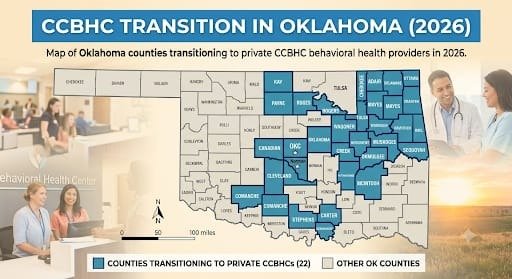
Why Behavioral Health Cash Flow Is Under Extra Pressure in Oklahoma Right Now?
In 2026, the Oklahoma Department of Mental Health and Substance Abuse Services (ODMHSAS) awarded one-year contracts to four private providers—Family and Children’s Services, Grand Mental Health, CREOKS, and Lighthouse Behavioral Wellness Centers. to take over behavioral health operations in 22 counties that used to be run by the state. These are Certified Community Behavioral Health Clinics, or CCBHCs, and they’re now responsible for crisis intervention, outpatient care, and peer support services in areas the state used to handle directly.
Here’s the part that matters for your cash flow: the private providers taking over these service areas aren’t getting some new pot of money to do it. They’re being paid through the existing Medicaid reimbursement system — the same SoonerCare pipes everyone else uses. If your practice operates in or near one of these 22 counties, or if you refer patients into that system, a transition like this can create real friction: new payer contacts, new authorization workflows, and staff who are still learning where things live. None of that shows up as “big news,” but it absolutely shows up in your accounts receivable a few months later.
And here’s the thing that should really get your attention: the state agency running this transition had a $43 million budget deficit last year and had to cancel provider contracts to close the gap. If ODMHSAS — with all its resources — struggled to keep behavioral health finances stable, that’s not a reason to panic, but it is a reason to take your own cash flow discipline seriously. The organizations that come through periods like this intact are the ones with tight billing processes, not the ones hoping things work out.
The SoonerCare Clock You Can’t Afford to Miss
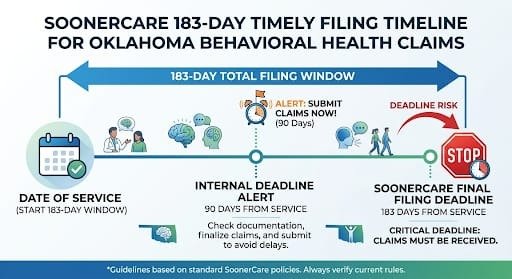
Every Oklahoma behavioral health practice needs to know this number cold: 183 days. That’s the timely filing limit for SoonerCare claims — six months from the date of service. Miss it, and the claim is dead. Not delayed, not appealable in the normal sense—dead. Oklahoma Administrative Code 317:30-3-11 doesn’t leave room for exceptions on this.
Here’s how a practice actually loses money to this rule, and it’s rarely dramatic. It’s not one huge claim that gets forgotten. It’s a slow accumulation: a biller goes on leave and claims sit for three weeks, a new EHR migration causes a backlog nobody flags as urgent, and a credentialing gap means claims can’t be submitted until a provider number clears. Each delay eats into that six-month window a little more, and by the time someone notices, a chunk of claims are past the point of no return.
If a claim is submitted within the 183 days and later gets denied, you get more runway to fix and resubmit it. But that grace period only exists if you cleared the first hurdle. Miss the original deadline, and there’s no second chance.
What to do about it: Don’t wait until day 180 to worry about a claim. Build an internal alert at 90 days — half the actual deadline — so slow-moving claims get flagged while there’s still plenty of room to fix whatever’s wrong with them. A claims-aging report that only checks in at the legal deadline isn’t a safety net; it’s a countdown clock.
Reducing Claim Denials in Oklahoma Behavioral Health Practices
Most cash flow problems trace back to a handful of repeat offenders. If you’re serious about reducing claim denials, Oklahoma behavioral health billing tends to break down in the same five places over and over:
Eligibility verification gaps
SoonerCare eligibility can and does change month to month, especially as post-pandemic Medicaid unwinding continues to shake out. A patient who was covered in January might not be covered in March. If your intake process checks eligibility once at the start of care and never again, you’re billing blind.
Credentialing delays tied to the CCBHC shift
If your practice is adjusting to a new CCBHC operator in your service area, provider enrollment and credentialing timelines can slow down during the handover. A therapist who’s fully qualified to see patients can still generate claims that go nowhere if their credentialing with the new entity hasn’t caught up.
Prior authorization bottlenecks.
Higher levels of care—Intensive Outpatient Programs (IOP), Partial Hospitalization Programs (PHP), and MAT—almost always require prior authorization. Start the service before the authorization clears, and you’re looking at a denial that requires an appeal, not just a resubmission. This is exactly why many Oklahoma practices lean on dedicated behavioral health prior authorization services rather than handling it ad hoc between front-desk tasks—the rules change often enough that having someone whose whole job is tracking payer-specific auth requirements pays for itself. This matters just as much for psychiatric medication management, where prior authorization requirements can be triggered by dosage changes or specific drug classes, not just the initial prescription.
Coding errors specific to behavioral health
This is a big one, and it’s sneaky because the codes look simple on paper. Confusing 90837 (60-minute individual psychotherapy) with 90834 (45-minute) is a common one. Group therapy codes like 90853 get denied when documentation doesn’t clearly show the group format and participant count. Codes like H0015 (intensive outpatient) and H2019 (therapeutic behavioral services) have specific documentation requirements that general medical billers — even competent ones — sometimes miss because they’re used to physical health coding, not behavioral health. This is also where telehealth psychology claim submission support becomes its own specialty: place-of-service codes and modifier requirements for virtual sessions (POS 10 vs. 02, GT/95 modifiers) trip up practices that only recently added telehealth and haven’t updated their claim templates accordingly.
Patient-responsibility collection gaps. When a patient has both commercial insurance and Medicaid, or a copay that SoonerCare doesn’t fully cover, that balance has to be collected somewhere. A lot of practices don’t have a real process for this — it becomes an afterthought, and afterthoughts don’t pay rent.
What CCBHC Reimbursement Means for Your Cash Flow
If your practice is directly involved in the CCBHC transition — either as one of the newly awarded operators or as a practice absorbing referrals from a former state-run site — it’s worth understanding how CCBHC reimbursement actually works, because it’s structurally different from regular fee-for-service billing.
Standard Medicaid billing pays per visit, per code. CCBHCs are reimbursed through a Prospective Payment System (PPS), which is built around cost reports rather than individual encounters. In plain terms: instead of getting paid claim-by-claim in the usual way, CCBHCs receive a daily rate designed to cover the full cost of providing the required scope of services, and that rate gets reconciled against actual cost data periodically.
That’s a very different rhythm than what most solo and group practices — including Oklahoma psychiatry medical billing services that mostly handle standard fee-for-service claims — are used to, and it means the usual “days in AR” math doesn’t map cleanly onto a CCBHC’s finances. If you’re transitioning into this, your billing touches an entity that has the practical takeaway: watch for changes in payer routing, new provider IDs, and possible claims resubmission during the handover. Don’t assume your old billing workflow will just keep working the same way it did under the state-run system.
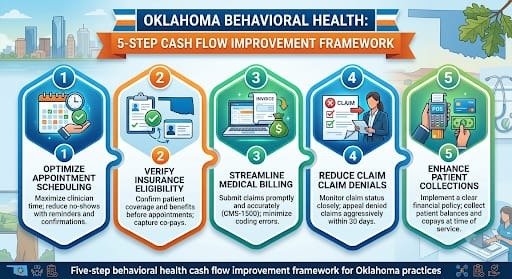
A Practical Behavioral Health Cash Flow Improvement Framework for Oklahoma Practices
None of this requires a total operational overhaul. It requires consistency on a few specific things.
Step 1: Verify eligibility the same day, every time. Not at intake and then never again—at every visit, or at minimum, weekly for active SoonerCare patients. Coverage churn is real, and catching a lapse before the session, not three months after, is the difference between a fixable problem and a write-off.
Step 2: Front-load your documentation. Medical necessity gets questioned after the fact, but it has to be established at the time of service. If your clinicians are writing notes that clearly support the code being billed—diagnosis, treatment plan, and session content that matches the CPT code—you’ll see fewer denials before they ever happen. This is cheaper than fighting denials after the fact.
Step 3: Track days in AR by payer, not just as one blended number. SoonerCare, commercial insurers, and self-pay behave completely differently. A blended AR number can look “fine” while one payer category is quietly falling apart underneath it. This is especially critical for dual-diagnosis facility accounts receivable management, where SoonerCare, commercial payers, and sometimes grant or block-grant funding all move through the same AR pipeline at very different speeds—a single blended AR figure can hide a serious problem in one funding stream.
Step 4: Set an internal filing deadline well inside the 183-day window. Thirty days from date of service is a reasonable internal target for most practices. That leaves five months of buffer for anything that goes wrong—resubmissions, corrections, staff turnover—without ever brushing up against the hard SoonerCare deadline.
Step 5: Keep a denial-reason log. Most practices don’t lose money to a huge variety of problems — they lose it to the same three or four mistakes happening over and over. If you’re not logging why claims get denied, you can’t fix the actual root cause, and you’ll keep bleeding revenue to the same error indefinitely.
In-House vs. Outsourced Billing: What Actually Moves the Needle
This is the question almost every practice owner asks eventually, and the honest answer is it depends on your size, your payer mix, and your staff bandwidth—not on which option sounds more impressive.
Outsourcing tends to help when you’re running multiple locations, your payer mix is heavily Medicaid (which comes with more rules and tighter documentation requirements), or your administrative staff is already stretched thin covering scheduling, intake, and billing all at once. This is also where specialization matters — substance abuse treatment center billing specialists, for instance, understand 42 CFR Part 2 confidentiality rules and SUD-specific authorization requirements in a way a generalist medical biller usually doesn’t, and that knowledge gap shows up directly in denial rates.
It tends to matter less when you’re a solo practitioner with a simple, mostly self-pay or single-payer setup and the bandwidth to stay on top of your own claims. In that case, a good EHR with built-in claims scrubbing and a disciplined weekly routine might get you just as far.
If you’re evaluating an outsourced billing partner, skip the vague marketing claims. “We improve cash flow by 25-40%” means nothing without context—ask instead for their actual denial rate by payer, their average days-to-payment for SoonerCare specifically, and how they handle credentialing during transitions like the current CCBHC shift. A real partner will have real numbers. A generic one will have generic promises.
A Cash Flow Health Checklist for Oklahoma Behavioral Health Practices
Keep this handy—print it, pin it, or whatever gets it in front of you regularly.
- Eligibility verified within the last 30 days for every active SoonerCare patient
- No claims older than 90 days without a documented follow-up action
- All clinicians credentialed with current payers, including any new CCBHC operators in your area
- Denial-reason log updated weekly, reviewed monthly for patterns
- Days in AR tracked separately by payer (SoonerCare vs. commercial vs. self-pay)
- Prior authorizations confirmed before IOP/PHP/MAT services or medication management changes begin
- Internal claims-filing target set well inside the 183-day SoonerCare deadline
- Documentation reviewed for medical necessity alignment with billed codes
- Telehealth claims checked for correct place-of-service codes and modifiers
- Patient-responsibility balances tracked and actively collected, not left to accumulate
- Front office staff trained on current behavioral health CPT/HCPCS codes (90837, 90853, H0015, H2019, etc.)
- A clear point person owns billing follow-up—not “whoever has time.”
FAQ
How long do I have to file a SoonerCare claim in Oklahoma?
Six months (183 days) from the date of service, per OAC 317:30-3-11. There are no exceptions for missing this window, so building in an internal buffer well before the deadline is essential.
What happens to my billing if my county’s CCBHC provider changes?
You may see changes in payer routing, provider IDs, or authorization processes during the transition. It’s worth confirming credentialing status and claims workflows directly with the new operator rather than assuming your existing process will carry over unchanged.
What’s a healthy AR days number for a behavioral health practice?
There’s no single magic number, but most well-run outpatient behavioral health practices aim to keep days in AR under 30-40 for the bulk of their claims, with SoonerCare claims often taking longer than commercial payers. The real signal to watch isn’t the average — it’s whether any single payer category is drifting upward over time.
Should a solo therapist in Oklahoma outsource billing?
Not necessarily. If your payer mix is simple and you have the time to stay disciplined about eligibility checks, coding, and follow-up, in-house billing can work fine. Outsourcing tends to pay off once claim volume, payer complexity, or administrative workload outpaces what one person can reliably track.
_________________________________________________________________________
Cash flow problems in behavioral health rarely announce themselves loudly. They show up as a slightly longer AR cycle here, a missed authorization there, and a claim that quietly aged past its filing window. None of it feels urgent in the moment—until it’s payroll week and the money that should be in your account is still sitting in a payer’s queue. Oklahoma’s behavioral health landscape is shifting right now, and that makes this a good time to invest in real behavioral health cash flow improvement in Oklahoma before the CCBHC transition turns any existing gaps in your process into something a lot more expensive.
_________________________________________________________________________
Not sure where your cash flow is actually leaking?
We help Oklahoma behavioral health and dual diagnosis practices tighten up billing, reduce denials, and stay ahead of SoonerCare deadlines — especially during transitions like the current CCBHC shift. [Schedule a free cash flow review→]
_________________________________________________________________________
This article is for general informational purposes and reflects publicly available Oklahoma Medicaid and ODMHSAS policy as of August 2026. It is not legal, financial, or compliance advice—verify current requirements with OHCA or your billing compliance team before making operational changes.