

If you’ve ever had a patient call your office asking why their walker still hasn’t arrived, there’s a decent chance the holdup wasn’t the DME supplier; it was the order your practice sent them. A missing NPI, a vague item description, a signature that looks a little too much like a stamp, and suddenly the supplier is faxing your front desk back for corrections while your patient waits at home without the equipment they need.
That order is called a Standard Written Order, or SWO, and it’s the one document standing between “claim approved” and “claim rejected” for nearly every piece of durable medical equipment Medicare covers. The rules aren’t complicated. They’re just easy to overlook when you’re writing dozens of orders a week between patient visits.
This guide breaks down exactly what belongs on a compliant DME Standard Written Order, the mistakes that cause the most rejections, and how practices can build a workflow that stops these delays before they start.
What Is a DME Standard Written Order (SWO)?
The SWO is the single order format Medicare has required for all durable medical equipment, prosthetics, orthotics, and supplies (DMEPOS) claims since January 1, 2020. Before that, different equipment categories had different order types verbal orders for some items and detailed written orders for others, and the inconsistency created constant confusion for physician offices and suppliers alike.
CMS consolidated everything into one standard under Final Rule CMS-1713-F. The Medicare standard written order requirement now applies the same way whether your patient’s claim runs through Noridian, CGS, or any other DME MAC. The specific contractor doesn’t change what has to be on the form; only who processes it.
Who’s allowed to sign one? Physicians, physician assistants, nurse practitioners, and clinical nurse specialists all qualify as “treating practitioners” under the rule. Chiropractors are the one notable exception; they cannot prescribe DMEPOS items under Medicare, regardless of clinical relevance.
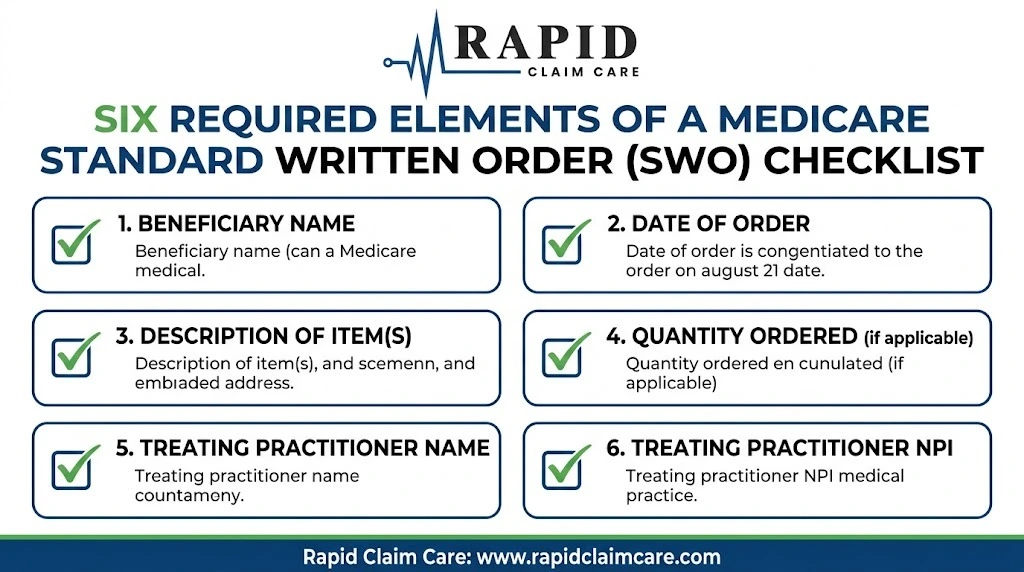
The 6 Required Elements of a Standard Written Order
Every SWO Medicare accepts needs these six pieces of information, no exceptions:
- Patient’s name or Medicare Beneficiary Identifier (MBI)
- Order date the date the order was actually written
- Description of the item a general description, HCPCS code, code narrative, or brand/model number all work. For equipment, list any billable accessories separately. For supplies, list each concurrently ordered item on its own line.
- Quantity to be dispensed, when applicable
- Treating practitioner’s name or NPI
- Treating practitioner’s signature
That’s the entire list. No diagnosis codes, no attached clinical narrative, no Certificate of Medical Necessity CMS retired CMNs back in 2023. The medical necessity documentation still has to exist, but it lives in the chart note, not on the order form itself.
Here’s a real-world way to think about it: imagine a 74-year-old patient recovering from a hip fracture who needs a hospital bed. The order needs the patient’s name, today’s date, “semi-electric hospital bed” or the matching HCPCS code, quantity of one, your name and NPI, and your signature. Five minutes, done. The clinical story about why she needs it post-surgical mobility restrictions, fall risk, whatever applies stays in her chart where it belongs.
Who Can Fill It Out vs. Who Has to Sign It
This distinction saves practices a lot of confusion. Your medical assistant or front-desk coordinator can absolutely fill in the patient details, item description, and quantity based on your instructions. What they can’t do is sign for you. The treating practitioner has to personally review the completed order and sign it — not authorize a stamp, not let someone sign on their behalf.
Power Mobility Devices are the exception worth flagging separately, since they carry stricter completion requirements and sit on Medicare’s high-audit-risk list. If your practice orders power wheelchairs or scooters even occasionally, it’s worth having a dedicated checklist just for those.
One more edge case: if the treating practitioner is also functioning as the equipment supplier — which happens in some rural and specialty settings — a formal SWO technically isn’t required. But the medical record still has to contain everything the six elements would have captured, so the workload doesn’t actually shrink.
When You Need a Written Order Prior to Delivery (WOPD)
Some items require more than a standard order the supplier needs the completed SWO in hand before the equipment reaches the patient. This is called a Written Order Prior to Delivery, or WOPD, and it applies to items on CMS’s Required List.
Power Mobility Devices are statutorily required to have a WOPD. Beyond that, the list changes periodically as CMS adds or removes items, so a practice that memorized the list two years ago might be working from outdated information today. If your patients regularly need equipment like specialized wheelchairs or certain respiratory devices, it’s worth a quick check against the current Required List before assuming a standard SWO covers it.
For items requiring WOPD, there’s also a face-to-face encounter requirement: the treating practitioner needs to have seen the patient within the six months before writing the order, and that visit has to be documented with enough clinical detail to support medical necessity. A CMS-compliant telehealth visit satisfies this; it doesn’t have to be in person.
This is where a lot of otherwise perfect orders get denied. The SWO itself is flawless, but the qualifying encounter happened seven months earlier instead of six, and the claim bounces anyway.
Common Reasons DME Orders Get Rejected
After reviewing enough denied claims, the same handful of issues show up again and again:
- Signature or date stamps. Medicare doesn’t allow these under any circumstances. A genuine handwritten signature or a compliant e-signature is the only acceptable format.
- Illegible or missing NPI. If the supplier can’t verify it, they can’t bill it. Typed or EHR-generated orders eliminate this problem entirely.
- Descriptions too vague to match the billed code. “DME per discussion” isn’t a description a supplier can work with order; then they’ll send it back for clarification, and that delay lands on the patient.
- Orders dated after delivery. Backdating to make paperwork line up retroactively is a documentation red flag that can trigger closer audit scrutiny, not just a processing delay.
- Missing a required new order. A fresh SWO is needed for new purchases, initial rentals, any change to the original order, item replacements, or a supplier switch where the new supplier can’t obtain the prior order. Assuming the old order “still counts” is one of the most common and most avoidable mistakes.
If your practice notices the same supplier sending back the same type of correction repeatedly, that’s usually a sign the issue is in your template or workflow, not a one-off error.
10 Frequently Asked Questions About DME Standard Written Orders
1. Does a DME Standard Written Order expire?
Not in the sense of a hard expiration date, but a new order is required for new purchases, initial rentals, and any change to the original order including quantity changes or item replacements.
2. Can a nurse practitioner or PA sign a Standard Written Order?
Yes. Physicians, PAs, NPs, and CNSs are all recognized treating practitioners under Medicare DMEPOS requirements. Chiropractors are not permitted to sign.
3. Are electronic signatures acceptable on an SWO?
Yes, as long as they meet CMS’s signature standards under the Medicare Program Integrity Manual. Stamped or date-stamped signatures are explicitly not acceptable, electronic or otherwise.
4. What’s the difference between an SWO and a WOPD?
An SWO is the baseline order required for every DMEPOS claim. A WOPD is that same completed SWO delivered to the supplier before the item reaches the patient required only for items on CMS’s Required List, like Power Mobility Devices.
5. Do supply orders need the same information as equipment orders?
The six core elements apply to both, but supply orders should separately list any concurrently ordered items that are billed individually, the same way equipment orders list billable accessories on their own lines.
6. What happens if my office sends an incomplete order?
The supplier generally can’t bill Medicare until the missing piece is corrected, which means the order comes back to your office and the patient’s equipment gets delayed in the meantime.
7. Does the face-to-face encounter have to happen in person?
No. A CMS-compliant telehealth visit within the six months before the order satisfies the requirement, as long as it meets CMS’s telehealth documentation standards.
8. Can staff fill out the order if the physician didn’t personally write it?
Yes, staff can complete the details based on the physician’s instructions, but the treating practitioner has to personally review and sign it. That step can’t be delegated.
9. Why do orders for Power Mobility Devices get denied more often than other DME?
PMDs sit on Medicare’s high-scrutiny list, with stricter completion rules and mandatory WOPD and face-to-face encounter requirements. A single missed detail encounter timing, signature format, documentation gaps is more likely to trigger a denial than it would for routine equipment like a walker or manual wheelchair.
10. How can a practice reduce SWO-related denials long-term? Standardizing your order templates against the six required elements, training front-desk staff on what they can and can’t complete, and periodically auditing rejected claims for patterns are the three changes that make the biggest difference. Many practices also outsource this review to a billing partner who tracks DME-specific denial trends across payers.

Getting This Right Without Adding to Your Workload
None of this is complicated once your team has a repeatable process. The problem is rarely a lack of knowledge; it’s that a busy practice writes dozens of orders a week, and a single missing NPI or vague description slips through when everyone’s moving fast. That’s exactly the kind of gap that shows up in denial reports six weeks later, long after anyone remembers writing the original order.
If your practice is seeing a pattern of DME orders bouncing back or you’re simply not sure how many of your Medicare DMEPOS claims are getting flagged before they’re paid, a focused billing audit is usually the fastest way to find out. Rapid ClaimCare’s DME billing team reviews order templates, denial reason codes, and documentation gaps specific to durable medical equipment claims, then hands your practice a clear, specific report, not a sales pitch.
Get Your Free DME Billing Audit →
Rapid ClaimCare provides HIPAA-compliant medical billing, denial management, and DME billing services for independent practices, group clinics, and community health centers across the U.S. Learn more about our DME billing services or book a free consultation to see where your practice may be losing revenue to preventable claim denials.