

If you’ve searched “DMEPOS bid pricing calculator” or “DMEPOS competitive bidding calculator,” you’ve probably landed on a page written for suppliers filling out bid worksheets. Most of what’s published on this topic is aimed at DME companies deciding how much to bid. If you’re running a family medicine practice, a community health clinic, or a private group practice, you don’t need to submit a bid; you need to know what’s about to change for your patients, your referral partners, and possibly your own billing.
That’s what this guide is for.
What Is DMEPOS Competitive Bidding, and Why Should a Physician Practice Care?
DMEPOS stands for Durable Medical Equipment, Prosthetics, Orthotics, and Supplies: wheelchairs, CPAP machines, walkers, ostomy supplies, CGMs, and diabetic testing supplies. Medicare doesn’t just pay whatever a supplier decides to charge for these items. In designated Competitive Bidding Areas (CBAs), Medicare sets a fixed reimbursement rate called the Single Payment Amount (SPA) through a process where DME suppliers submit bids and CMS selects winners using a Medicare DMEPOS bid calculator tool built around SPA calculation logic.
Here’s the part that actually matters to you: only suppliers who win a contract can furnish those items to Medicare patients in that area at Medicare’s payment rate. If your longtime DME partner, the one who’s fitted your COPD patients with CPAP machines for a decade doesn’t win a contract, they’re out. Your patient now has to find a new supplier, possibly one they’ve never worked with, possibly one that only ships by mail.
That’s a real disruption to continuity of care, and it happens quietly, buried in a CMS rule update most physicians never see. It’s also the kind of change that shows up as a billing headache before anyone connects it back to a bidding round a claim gets denied or a prior authorization gets rejected because the supplier on file is no longer a valid contract holder.
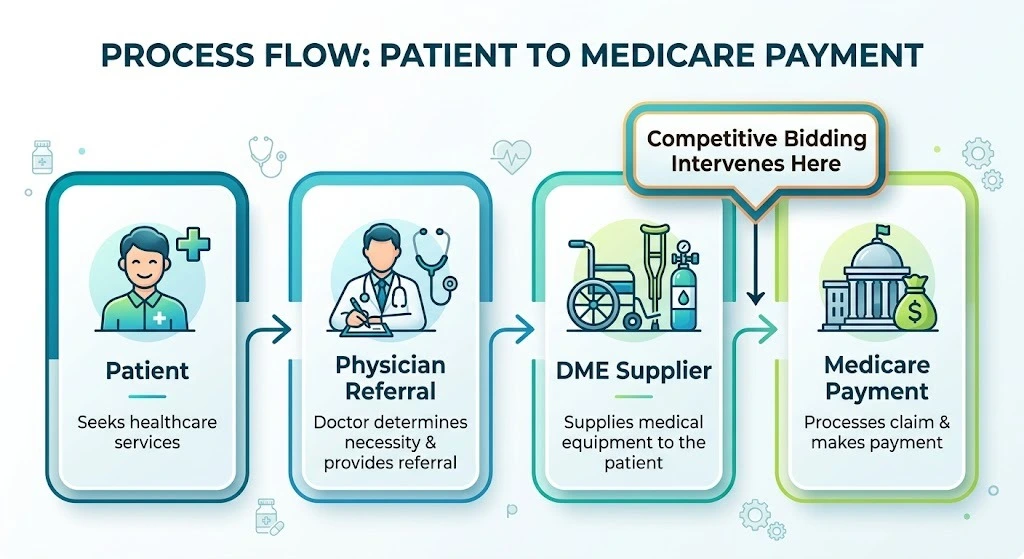
The next round — Round 2028 — is happening now. Bidding began in 2026, contracts get awarded in late 2027, and new rates take effect January 1, 2028. If you have patients on affected equipment, this is the window to pay attention.
How the DMEPOS Bid Pricing / Competitive Bidding Calculator Actually Works
You don’t need to become a bidding expert, but understanding the basic mechanics clears up a lot of confusion even among suppliers.
Lead items set the price for everything else.
Within each product category (say, walkers, or CGMs), CMS designates one “lead item.” Suppliers bid a price on that lead item only. CMS then uses pre-set ratios to calculate payment rates for every other code in the category based on that single bid. This is the core of lead item bid price calculation DME logic: one number cascades into reimbursement for a dozen or more related products.
There are bid limits.
Suppliers can’t bid above a set ceiling (for Round 2028’s off-the-shelf orthoses, that ceiling ties to the average 2026 Medicare fee schedule amount). This exists to prevent runaway pricing, but it also puts real pressure on suppliers to price competitively, pressure that ripples downstream, as you’ll see below.
Round 2028 changed how the final rate gets set.
In earlier rounds, the payment rate was based on the maximum winning bid; if five suppliers won contracts, everyone got paid at whatever the highest of those five bids was. Round 2028 switches to the 75th percentile of winning bids. That sounds like a technical footnote, but it isn’t. Winning bidders are now more likely to get paid close to what they actually bid, with less room to bid aggressively low and hope a higher outlier bid bails them out. Expect tighter margins for winning suppliers, and tighter margins are exactly what pushes smaller, community-based suppliers out of a market.
Purchase price and monthly rental are not the same column.
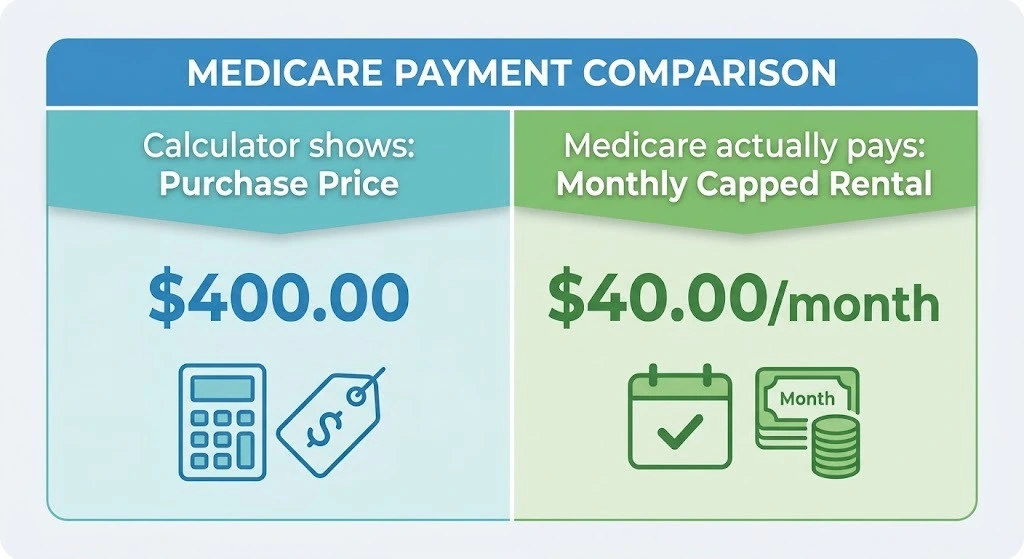
This trips people up constantly, including suppliers. Some items appear in the calculator as a purchase price, but Medicare actually pays for them as a capped rental; the supplier gets a fraction of that price each month, not the full amount upfront. If you’ve ever wondered why a supplier seems reluctant to stock a particular rental item, this pricing structure is often why.
Worked Example: Lead Item Bid Price Calculation in DME
Let’s make this concrete using a real mechanic from the calculator (a walker code, E0140, illustrating how the math cascades figures simplified for clarity).
Say a supplier bids $100 on a lead item in the walker category. Based on the ratio built into the calculator, a related code, E0140, with a purchase (NU) modifier comes out to a calculated rate of $310.13. That looks like a healthy number. But E0140 isn’t paid as a lump-sum purchase; it’s paid as a capped rental. So the supplier divides $310.13 by 10 (the standard rental division) to get the actual monthly payment: about $31.01.
Now play that forward to your patient. If the lead item bid comes in low this round because the 75th-percentile rule is squeezing bidders toward tighter numbers, that $31.01 monthly rental rate could shrink further. A supplier running on thin margins may decide the category isn’t worth staying in, especially competing against a small number of national contract winners under the new Remote Item Delivery model. Fewer local suppliers willing to carry an item means your patient either waits longer, gets it mailed from an out-of-state supplier they’ve never dealt with, or can’t get it locally at all.
This is the same logic behind most DME competitive bidding profit margin software: a bid input that cascades into a payout, minus cost, equals margin. When margins compress at the supplier level, the effect eventually reaches your exam room, and for practices that bill DMEPOS directly, your reimbursement statements.
What’s New in Round 2028 That Practices Should Know
Skip the bidder-only mechanics (surety bonds, credit reporting requirements) and focus on what actually touches your patients:
New product categories.
Round 2028 expands competitive bidding into categories that weren’t previously included in some markets CGMs and insulin pumps, ostomy supplies, urological supplies, and off-the-shelf orthoses (knee, spinal, and upper extremity), among them. Any current or future DMEPOS product category bid estimator you check should reflect these additions. If you manage diabetic patients or write orthosis prescriptions, this round touches you directly in a way earlier rounds may not have.
Remote Item Delivery (RID) for off-the-shelf orthoses.
This is a real structural shift. For OTS knee, spinal, and upper extremity orthoses, CMS is awarding a small number of contracts nationally, as few as three to five, with fulfillment happening mostly through mail order rather than local dispensing. If you’ve been sending a patient down the hall to a local orthotics provider for a knee brace, that option may functionally disappear for Medicare patients in this category.
The 75th-percentile SPA calculation.
Covered above is worth repeating here because it’s the single biggest lever behind supplier participation and network stability going into 2028.
A pandemic-era contract termination clause.
CMS can now terminate competitive bidding contracts during a public health emergency to expand beneficiary access quickly. A reminder: this system keeps evolving in response to real-world lessons.
If Your Practice Dispenses DMEPOS Directly (Rural Health Clinics, In-Office Dispensing)
Some practices, particularly rural health clinics and practices with in-office dispensing arrangements, bill Medicare directly for items like walkers, braces, or diabetic supplies. If that’s you, two things matter here.
First, whether competitive bidding rules apply to you comes down largely to geography: is your practice location inside a designated Competitive Bidding Area? Being inside a CBA can mean you need to be a contract supplier yourself to keep billing certain codes at Medicare’s rate.
Second, if your practice wants to remain (or become) an eligible supplier for any newly added category, there’s an accreditation and enrollment process with deadlines tied to the bid window. Suppliers use bid calculators and margin-modeling tools before submitting. If your practice enrolls as a supplier, you’ll want that same visibility into your own cost structure before committing, and clean claims and accurate DME coding matter even more once you’re competing under tighter reimbursement margins. This is where DME Billing Services and Provider Credentialing support come in the enrollment paperwork and payer-specific coding rules are exactly the kind of detail that determines whether a claim gets paid on the first pass or ends up in a denial queue.
What This Means for Your Patients and Referral Network
Two practical moves are worth making now, well before contracts are even awarded.
Talk to patients proactively, not reactively. If a patient relies on a category affected by Round 2028 CGMs, ostomy supplies, orthoses a brief heads-up now goes a long way: their supplier or delivery method might change in 2028, and that’s a normal program update, not a sign anything is wrong with their care.
Audit your referral relationships before contracts are announced. Once Round 2028 contract winners are published (expected late 2027), check your most-used DME referral partners against that list. Finding out a reliable supplier didn’t win a contract is far better done ahead of time than when a patient shows up needing equipment. It’s also worth watching your own claims data during this transition a spike in denials tied to a specific supplier or product category is often the earliest sign something changed upstream. This is the kind of pattern AR Recovery and denial management work is built to catch before it becomes a backlog.
Action Checklist for Practice Managers
- Identify affected patients. Pull a rough list of which product categories CGMs, ostomy, urological, OTS orthoses, walkers, wheelchairs show up most often in your patient population.
- Check your CBA status. Confirm whether your practice’s location falls inside a competitive bidding area, especially if you bill DME directly.
- Review current DME referral partners. Note which suppliers you rely on most, so you’re ready to compare them against the contract winner list once published.
- Bookmark the CBIC Round 2028 timeline. Contract awards are expected late 2027, with rates effective January 1, 2028.
- If you bill DMEPOS directly, confirm enrollment and accreditation status now. Don’t wait for the bid window to close.

Frequently Asked Questions
1. Do physician practices have to bid in the DMEPOS Competitive Bidding Program?
No. Bidding is for DME suppliers, not physician practices. The exception is practices that directly bill Medicare as DME suppliers, which may need enrollment and accreditation if located in a competitive bidding area.
2. What happens to my patients if their DME supplier doesn’t win a contract?
The patient needs to switch to a supplier that won a contract for that product category and area, which may mean a new company, a different delivery process, or a short transition gap.
3. How do I know if my practice is in a competitive bidding area?
CMS’s Competitive Bidding Implementation Contractor (CBIC) publishes the current CBA list by ZIP code on its official site; check there directly, since areas can shift between rounds.
4. What’s the difference between a lead item and a non-lead item in the calculator?
The lead item is the one product suppliers actually bid a price on. Every other code in that category, the non-lead items, has its rate calculated automatically from that bid using preset ratios.
5. When does Round 2028 take effect?
The bid window opened in 2026, contract awards and final rates are expected late 2027, and new rates go into effect January 1, 2028.
6. Will my patients’ out-of-pocket costs change under Round 2028?
Possibly. Since SPAs are recalculated using the new 75th-percentile method, coinsurance amounts (typically 20% of the SPA) can shift up or down depending on how the new rates land in your area.
7. What product categories are newly included in Round 2028?
CGMs and insulin pumps, ostomy supplies, urological supplies, and off-the-shelf orthoses (knee, spinal, and upper extremity) are among the categories added or expanded this round.
8. Does competitive bidding affect Medicare Advantage patients too?
Competitive bidding rates apply to Original Medicare. Medicare Advantage plans aren’t required to use the same SPAs, though many reference them when setting their own DME payment structures check with individual plans for specifics.
9. What is Remote Item Delivery (RID), and does it affect all DMEPOS categories?
RID is a mail-order-based fulfillment model introduced for select Round 2028 categories currently off-the-shelf orthoses where a small number of national contract suppliers fulfill orders remotely rather than through local dispensing.
10. Where can I find the official CMS bid pricing calculator and current Round 2028 updates?
The Competitive Bidding Implementation Contractor (CBIC) website is the authoritative source for calculators, FAQs, and timelines; it’s updated directly by CMS and is the most reliable place to confirm current figures before making any decisions.
A Note on Staying Current
Competitive bidding rules shift as CMS finalizes contract counts, bid limits, and product category lists; some of the specifics here may be updated before Round 2028 contracts are finalized. If you’re making a decision that hinges on exact figures (a bid limit, a CBA boundary, a contract count), confirm it against the CBIC website before acting on it.
Round 2028 contract awards won’t be announced until late 2027, but the changes that affect your patients and your claims start now. Rapid ClaimCare’s certified billing and credentialing team already tracks CMS reimbursement changes like this as part of everyday DME and specialty billing work, so if you want a second set of eyes on your CBA status, referral network exposure, or supplier enrollment paperwork before the bid window closes, book a free consultation and we’ll walk through it with you.