

Search “internal medicine medical billing Indiana” and you’ll land on a wall of vendor ads. Big national RCM companies, the same three promises about “reducing leakage” and “accelerating cash flow,” and a contact form waiting at the bottom of every page. None of them tell you why your CCM claims keep getting denied or what to actually ask before signing a billing contract. That’s the gap this guide fills.
Everything below reflects patterns we see play out across independent internal medicine practices, community clinics, and group practices billing payers in Indiana — the same patterns that shape how we run internal medicine billing for our own clients.
Why Internal Medicine Billing Is Different From General Practice Billing?
Most billing advice treats “medical billing” as one uniform problem, and that’s exactly where it falls apart for internal medicine. A pediatric practice and an internal medicine practice can run identical software and identical front-desk workflows and still end up with wildly different denial rates because the underlying patient population—and the codes it generates—isn’t the same.
Internal medicine skews older, sicker, and more Medicare-heavy. A single 68-year-old patient with diabetes, hypertension, and early kidney disease doesn’t generate one clean E/M code. She generates chronic care management time, risk-adjustment documentation, medication reconciliation, and care coordination—all of which need to be captured correctly, or they simply vanish from your revenue. For internal medicine practices’ billing in Indiana specifically, that complexity is layered on top of state-specific Medicaid and MCO rules most national billing guides never mention.
That’s why generic revenue cycle management advice tends to underperform here — it’s tuned for lower-acuity, lower-complexity visits. The codes below are where internal medicine practices actually make, or quietly lose, their money.
The Core CPT Codes Driving Internal Medicine Revenue (and Denials)
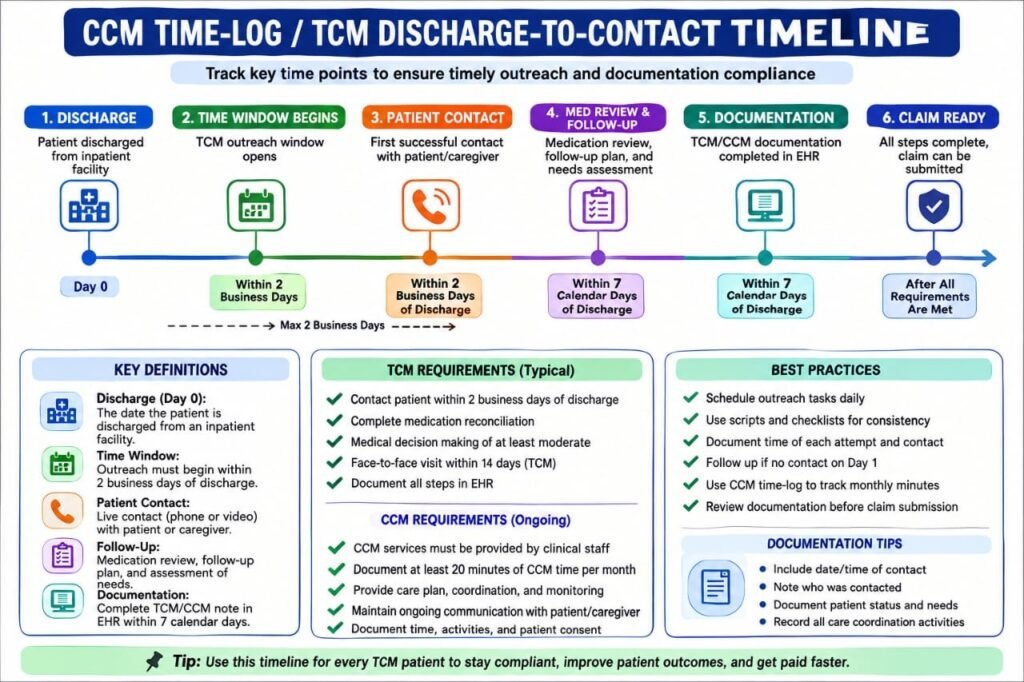
Chronic Care Management (CCM) — 99490, 99439 CCM pays for work your staff is likely already doing: coordinating care, managing medications, checking in between visits. The requirement is 20 minutes of clinical staff time per calendar month for patients with two or more chronic conditions, and it has to be logged and dated, not just implied. We’ve seen practices doing the clinical work of CCM for months without billing a single dollar of it, simply because no one was tracking minutes.
Transitional Care Management (TCM) — 99495, 99496 TCM covers the 30 days after a hospital discharge and pays well, but the timeline is strict: an interactive contact within two business days of discharge and a face-to-face visit within 7 days (99496) or 14 days (99495). Miss the two-day contact window, and the claim isn’t billable as TCM at all—not reduced, just gone. The most common reason internal medicine practices lose TCM revenue is that nobody in the office finds out about the discharge until it’s already too late.
Annual Wellness Visit (AWV) — G0438, G0439 The AWV isn’t a physical, and billing it as one is a fast route to denial. It’s a Medicare preventive benefit built around a health risk assessment and prevention plan. Bill it alongside a problem-focused E/M on the same day, and you need modifier -25 plus documentation that clearly separates the two—otherwise expect one of the two claims to bounce.
E/M Level Selection and Prolonged Services Since the 2021 guideline overhaul, E/M level selection runs on medical decision-making or total time, not checkbox counting. Internal medicine visits, which often involve managing several chronic conditions at once, frequently support a higher level than what’s actually being billed. This kind of undercoding is quiet—nobody notices a single 99213 that should have been a 99214—but across a full patient panel, it adds up every month.
HCC and Risk-Adjustment Coding For patients on Medicare Advantage plans, every diagnosis you document (or don’t) shapes the risk score CMS uses to calculate that patient’s payment for the year. A chronic condition that isn’t re-documented annually effectively disappears from the risk profile the next year — quietly leaving Medicare Advantage revenue unclaimed, even though the condition is still being actively managed.
Billing Indiana Medicaid and Managed Care Plans for Internal Medicine
Indiana’s Medicaid system has quirks worth knowing before they cost you a claim.
IHCP (Indiana Health Coverage Programs)
runs its own enrollment portal, claim-submission rules, and timely-filing windows, separate from Medicare or commercial payers. Applying Medicare’s filing logic to an IHCP claim produces denials that look random but aren’t.
The Healthy Indiana Plan (HIP 2.0)
is Indiana’s Medicaid expansion program, and it includes POWER accounts—HSA-like accounts that require member contributions. Eligibility can shift based on POWER account status in ways a standard eligibility check won’t always catch, so it’s worth verifying at every visit, not just at intake.
Indiana Medicaid MCOs
Anthem BCBS Indiana, MDwise, CareSource, and MHS — each run their own prior authorization rules, claims platforms, and appeals processes. Being credentialed with Indiana Medicaid overall doesn’t mean you’re cleanly set up with all four MCOs individually. Credentialing gaps here are one of the most common reasons a new physician’s claims are denied in their first few months, even with correct coding.
Budget real time for this: Indiana payer credentialing commonly runs 60–120 days, and claims submitted before credentialing finalizes are denied outright. Practices that don’t plan for this lag often end up with a provider seeing patients for two or three months before a single claim can be submitted. For a broader look at what billing looks like across the state, see our Indiana medical billing services page.
In-House vs. Outsourced Billing: What It Actually Costs
There’s no universal right answer — it depends on your volume, payer mix, and how strong your current billing team already is.
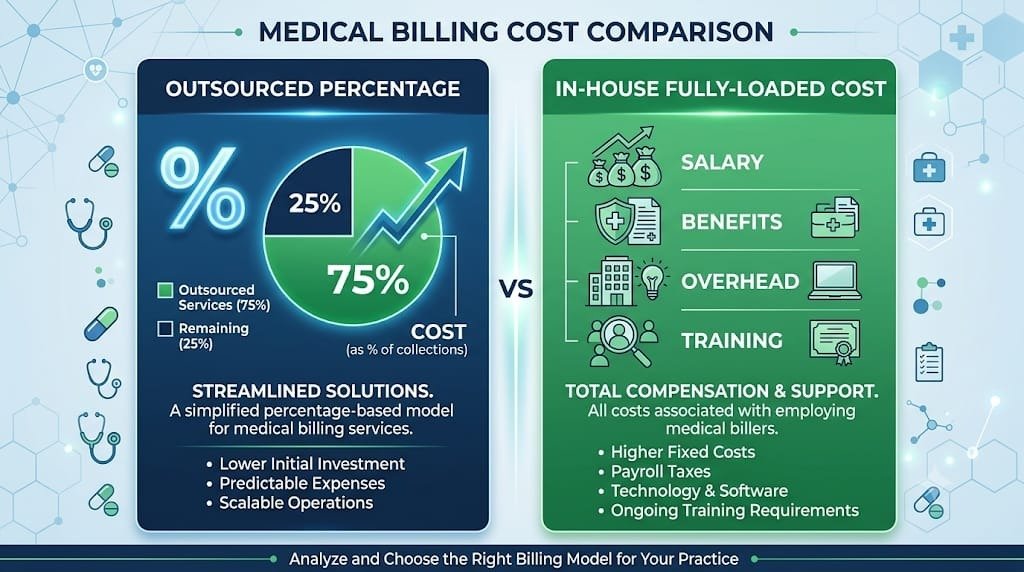
Outsourced billing typically runs 3–8% of collections, with specialty-heavy practices (more CCM/TCM/HCC complexity) often landing at the higher end since there’s more work per claim. At Rapid ClaimCare, that’s performance-based pricing with no setup fees and no long-term lock-in—you pay when claims get paid.
In-house billing costs more than most practices initially estimate. A single experienced biller’s salary and benefits commonly land in the 45,000–65,000 range depending on region before adding practice management software, clearinghouse fees, and ongoing training as payer rules shift.
A rough break-even test: if 5–7% of your monthly collections consistently exceeds the fully loaded cost of an in-house biller, outsourcing is likely costing you less than keeping it in-house. Below that threshold, outsourcing usually wins on cost and consistency — particularly for smaller practices that can’t justify a full-time specialist in CCM and TCM rules. Watch for costs that don’t show up in the headline percentage: onboarding fees, separately billed software licenses, and multi-year lock-in contracts.
How to Vet a Physician Billing Services Partner
Most billing companies claim to handle “primary care” or “internal medicine.” Few can explain, specifically, how they track CCM time or catch TCM’s contact window—which is the real test.
Ask directly:
- “Walk me through how you track and bill CCM time each month.”
- “How do you catch TCM’s two-day contact window after a hospital discharge?”
- Have you credentialed providers with Indiana Medicaid MCOs—Anthem, MDwise, CareSource, and MHS—recently? What did that timeline actually look like?”
- “What’s your first-pass claim acceptance rate, and how often do you report denial trends to me?”
- “Are your processes HIPAA-compliant, and can you show a signed BAA and documentation of that?”
Red flags: pricing that stays vague until you’re deep into a sales call, no ability to name specific Indiana payers they’ve actually worked with, and contracts with long lock-in periods and no clear data portability clause. That last point matters — if the relationship doesn’t work out, your billing data and claim history need to move with you.
Common Billing and Coding Mistakes in Internal Medicine Practices
Most of what follows is denial management in disguise — the same handful of gaps causing the same predictable denials, practice after practice.
- Under-documenting CCM/TCM time. The clinical work happens; the minute-by-minute log that makes it billable doesn’t.
- Billing AWV and a same-day E/M without modifier -25. An easy, mechanical fix once staff know to check for it.
- Letting HCC documentation lapse year to year. No denial, no red flag — just revenue that quietly stops being captured.
- Missing Medicare frequency limits. A quick eligibility check catches this before it becomes an automatic denial.
- Treating credentialing as a one-time task. Being credentialed with Medicare doesn’t mean being credentialed with every Indiana Medicaid MCO—and that gap causes denials that look like coding errors but are really enrollment errors.
If your practice is regularly running into these, it’s worth a real audit of your current claims process before assuming outsourcing is the fix—sometimes it’s a workflow gap that better tracking and follow-up solve on their own. Aging, unresolved claims from any of the issues above are also where A/R recovery work tends to concentrate.
Frequently Asked Questions
How much does medical billing cost for an internal medicine practice in Indiana? Outsourced billing typically runs 3–8% of collections. In-house billing costs the fully loaded expense of a biller (often 45,000–65,000+ annually) plus software and clearinghouse fees.
Does Indiana Medicaid cover chronic care management billing? IHCP and its MCOs generally follow CMS’s CCM framework, but confirm current requirements with the specific MCO—Anthem, MDwise, CareSource, and MHS don’t all process claims identically.
Should a small internal medicine practice outsource billing or hire in-house? For solo and small group practices, outsourcing usually costs less than a full-time in-house biller once salary and benefits are factored in. Larger practices with higher collection volume sometimes find in-house or hybrid models cheaper per dollar collected.
What’s the difference between an AWV and a regular physical for billing purposes? An AWV is a Medicare preventive benefit built around a health risk assessment, not a hands-on physical exam. Billing it as a physical, or bundling it with a same-day E/M without modifier -25, is a common cause of denials.
How long does payer credentialing take in Indiana? Commonly 60–120 days across Medicare, commercial payers, and Indiana Medicaid MCOs. Start credentialing well before a new provider’s start date.
What happens if we miss the TCM two-day contact window? The claim isn’t billable as TCM at all — there’s no partial credit. The visit may still be billable as a standard E/M, but the higher TCM reimbursement is lost.
Can we bill CCM and TCM for the same patient in the same month? Generally no — CCM and TCM can’t be billed concurrently for the same patient in the same service period under current CMS rules. Confirm current guidance before billing both.
Do we need separate credentialing for each Indiana Medicaid MCO? Yes. Enrollment with IHCP doesn’t automatically credential a provider with every MCO—Anthem, MDwise, CareSource, and MHS each require their own credentialing process.
What denial rate should we consider normal, and when is it a red flag? Denial rates vary by payer mix, but a well-run internal medicine practice should be seeing a first-pass claim acceptance rate in the mid-90s or higher. Consistently lower than that usually points to a specific, fixable issue — often credentialing gaps or missing documentation — rather than something reflecting the whole billing relationship.
How do we know if our practice is losing HCC revenue? A quick audit comparing this year’s documented chronic conditions against last year’s is usually the fastest way to spot the gap—conditions that were active last year but aren’t re-documented this year are the ones quietly falling off the risk profile.
Where This Leaves You?
If CCM time is going untracked, TCM windows are being missed, or Indiana Medicaid credentialing is holding up revenue, those are fixable, specific problems—not a sign you need to overhaul your entire billing operation. Start with an audit of where your practice actually stands before deciding whether the fix is a workflow change, a new hire, or outsourced revenue cycle management.
Get your free revenue audit and see what’s actually being left on the table—most practices we review are surprised by the answer.
Every practice’s payer mix and patient population are different—the figures and timelines above are general benchmarks, not guarantees. Confirm current requirements directly with IHCP, your MCOs, or CMS before making billing decisions.