

How to Handle Denials and Appeals Like a Pro?
Chiropractic care is often misunderstood. Discover 6 common myths about chiropractic adjustments and the surprising facts about safety, effectiveness, and long-term benefits.

After working with hundreds of chiropractic and mental health practices over the past decade, I’ve noticed a pattern, the most successful practices aren’t necessarily seeing more patients they’re just better at managing their revenue cycle. And it all starts with tracking the right metrics.
Here’s the uncomfortable truth: most practitioners focus entirely on patient care (as they should!), but their billing operations? That’s where thousands of dollars quietly slip through the cracks every single month.
You don’t need an MBA or a finance background. You just need to watch the right numbers and take action when they drift off course.
Let me walk you through the six key medical billing metrics that can transform your practice’s financial health.
Every week, I talk to practice owners who tell me, “We’re busy, we’re seeing patients, but we’re not profitable.” When we dig into their numbers, it’s rarely a patient volume problem. It’s a revenue leakage problem.
The practices that monitor these six billing metrics monthly. They typically improve their revenue by 15-25% within six months. Not by working harder. Not by seeing more patients. Simply by tightening up what was already there.
Let’s break down each metric and what it means for your practice.
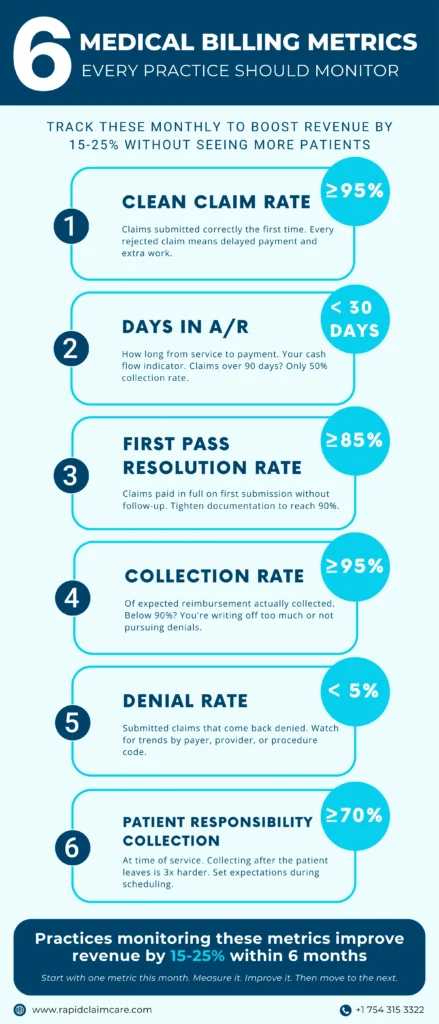
Your clean claim rate tells you what percentage of claims are submitted without errors on the first try. This is your billing team’s report card, and it’s one of the most important numbers to watch.
Why it matters: Every rejected claim means delayed payment, extra administrative work, and frustrated staff. If you’re running below 90%, you’re burning money on rework that shouldn’t exist.
What we see in the field: Chiropractic practices often struggle with modifier usage and medical necessity documentation. Mental health clinics frequently deal with authorization-related rejections. Therapy practices sometimes miss timely filing deadlines because they’re waiting on documentation.
My recommendation is to pull your top three denial reasons from last month. I’ll bet you see the same issues repeating. Fix those three things, and you’ll jump 5-10 percentage points immediately.
Chiropractic care is often misunderstood. Discover 6 common myths about chiropractic adjustments and the surprising facts about safety, effectiveness, and long-term benefits.
Days in Accounts Receivable measures how long it takes to collect payment after you’ve provided a service. This is your cash flow indicator.
Reality check: If you’re consistently over 45 days, you have a collections problem. The data is clear on this the older a claim gets, the exponentially less likely you are to collect. Claims over 90 days old? You’ll be lucky to collect 50%.
For mental health practices specifically: Insurance verification delays are your enemy here. Patients come in for urgent care, you provide services, then find out three weeks later they weren’t eligible. By then, collecting from the patient is an uphill battle.
What successful practices do: They verify benefits before the appointment (or at least before the claim goes out). They follow up on unpaid claims at 14 days, not 30. They don’t let things age.
This metric tells you what percentage of your claims are paid in full on the first submission without any follow-up needed. And yes, this is different from your clean claim rate.
Here’s the distinction: A claim can be “clean” (no errors, accepted by the payer) but still get partially paid, downcoded, or denied for medical necessity. First pass resolution means the payer looked at it and paid it. Done.
If your rate is low, look at your documentation. Are you supporting the services with proper notes? For chiropractors, are you documenting medical necessity for maintenance care? For therapists, are your progress notes justifying continued treatment?
I’ve seen practices go from 70% to 90% first pass resolution just by tightening up their documentation templates. That’s real money hitting your account faster with less effort.
Your collection rate is calculated as total payments divided by total charges, adjusted for contractual write-offs. This tells you how much of what you should be collecting you’re actually collecting.
The honest truth: If you’re collecting under 90%, you’re either writing off too much or not pursuing denials and underpayments. Both are fixable problems.
For therapists doing superbills and out-of-network claims: These often have lower collection rates because patients don’t understand their benefits or can’t afford the upfront cost. Set financial expectations during the scheduling call, not after the first session. Consider payment plans or sliding scales if you’re in the mental health space, it’s better than writing off the full amount.
For chiropractors: Watch for downcoding. If you’re consistently getting paid for a lower-level E/M code than you billed, your documentation isn’t supporting your coding level.
Your denial rate is simply the percentage of submitted claims that come back denied. This should be low, and if it’s not, it’s a red flag.
Watch for trends. Is your denial rate increasing month over month? Is one payer causing 80% of your denials? Is it one provider in your practice? One specific procedure code?
For chiropractic practices: Authorization issues are huge. Some plans require pre-auth after 12 visits, some after 20. If you’re not tracking this by payer, you’re getting denials.
For mental health practices: Timely filing kills you. Between getting records from hospitals, coordinating with other providers, and documentation delays, claims age quickly.
For all practices: Medical necessity is the denial reason that requires the most work to overturn. Prevention is way easier than appeals.
This measures how much of the patient portion (copays, deductibles, coinsurance) you’re collecting. And let’s be real: collecting after the patient walks out is three times harder than collecting before or during the visit.
Your front desk holds the key to your cash flow. If they’re uncomfortable asking for payment, or if they don’t know what to collect, you’re losing money every single day.
Best practice from high-performing practices: Estimate patient responsibility during the scheduling call. “Your insurance shows a $40 copay, and you haven’t met your deductible yet, so we’ll collect $X at your visit.” No surprises means better collections and happier patients.
For mental health practices: This is especially critical if you’re out of network or doing self-pay. Discuss fees in the initial consultation. Have a clear financial policy. Consider collecting payment at the start of the session, not the end.
You don’t need expensive analytics software to track these metrics. I’ve seen practices do this effectively with a simple spreadsheet that takes 15 minutes to update each month.
Here’s what your dashboard should show:
✓ Clean Claim Rate
✓ Days in A/R
✓ First Pass Resolution Rate
✓ Collection Rate
✓ Denial Rate
✓ Patient Responsibility Collection Rate
Track these monthly. Compare month-over-month and year-over-year. When you see something trending in the wrong direction, dig in immediately.

I know what you’re thinking: “This sounds like a lot.” And yes, if you’re not tracking any of this right now, it can feel overwhelming.
So here’s my advice: pick one metric to focus on this month. Just one.
If you’re constantly dealing with claim rejections, focus on your clean claim rate. If cash flow is tight, focus on days in A/R. If you’re writing off a lot of services, focus on your collection rate.
Improve that one metric. Get it to target. Then move to the next one.

After a decade in this industry, here’s what I know for certain: practices that consistently monitor these six metrics don’t just survive, they thrive. They have better cash flow, less staff stress, fewer write-offs, and more predictable revenue.
They’re not working harder. They’re working smarter.
Your billing operations should support your practice, not drain it. These metrics give you the visibility to make that happen.
Discover your top denial reasons with a free billing analysis.
Limited slots!
Review billing metrics monthly at a minimum. Many successful practices set aside 30 minutes at the start of each month to review the prior month’s results. If you’re actively fixing issues like denials or high A/R, do weekly spot checks on those specific metrics. Consistency matters more than frequency, put it on the calendar and treat it like a business priority.
A healthy target is 95% or higher of expected reimbursement (after contractual adjustments). Below 90% usually signals lost revenue. Mental health practices with out-of-network billing often see 80–85% Chiropractic practices with many high-deductible patients may land around 85–90% To improve: verify benefits before visits, set payment expectations upfront, and follow up on unpaid claims within 14 days, not months later.
Rising denials usually come from: Payer policy changes Documentation gaps Front-end errors (authorizations, demographics, eligibility) Run a denial report and group denials by reason. Typically, 3–5 issues cause most denials. Fix those with targeted training, clearer workflows, or better documentation templates. Chiropractors: monitor visit limits Mental health practices: tighten authorization and timely filing processes
Clean claim rate: claims submitted correctly and accepted by the payer (no data errors). First pass resolution rate: claims paid in full on the first submission, with no follow-up. A claim can be clean but still underpaid or downcoded. That’s why first pass resolution is the stronger indicator of revenue cycle performance.
Most systems (Jane, SimplePractice, ChiroTouch, Kareo) already track these metrics. If not, a basic spreadsheet works. Once a month, enter just six numbers: Claims submitted Claims paid on first pass Total charges Total payments Total denials Patient payments collected at the time of service The tool matters less than the habit. Practices that track even 2–3 metrics monthly consistently outperform those that track none.